
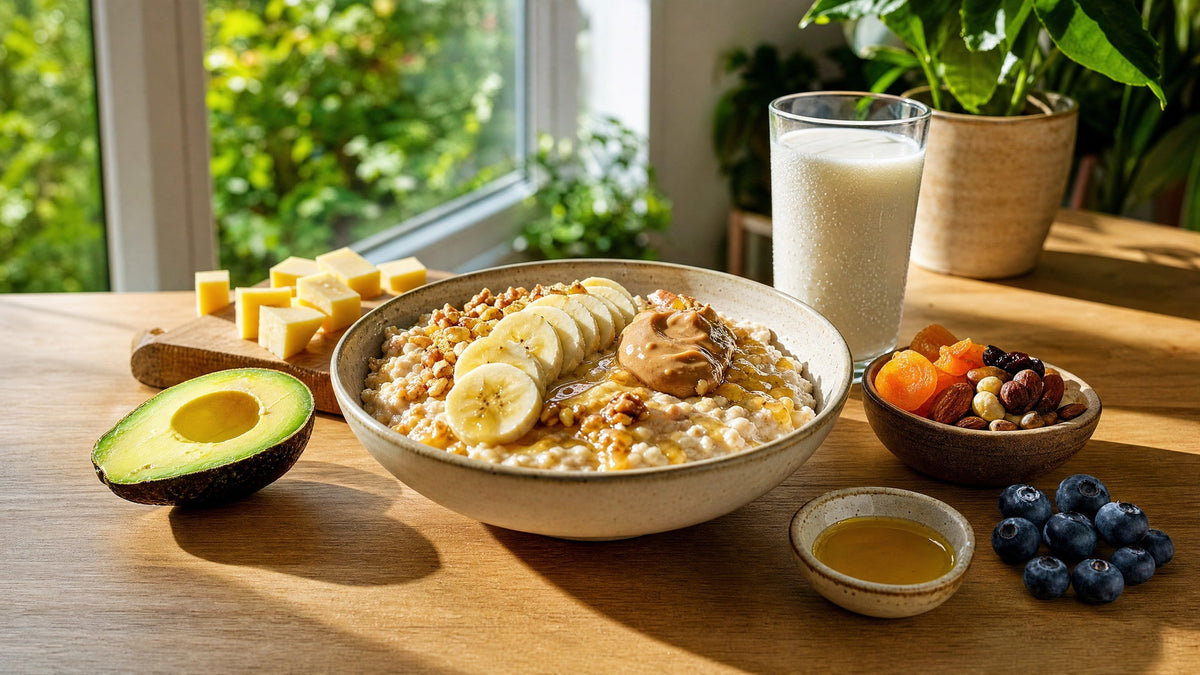
Gaining weight means: You eat 300 to 500 kcal more every day than your body burns in total. To do this, you eat energy-dense foods and spread them over several smaller meals. Add enough protein, strength training if needed, and patience: This works out to roughly 0.25 to 0.5 kg per week. This is a calculation, not a prediction.
The 0.25 to 0.5 kg is based on the rule of thumb that a surplus of around 7,700 kcal corresponds to one kilo, and this is only a rough approximation. Therefore, assess the progress after a few weeks.
This guide applies to healthy adults. Different values apply to children, adolescents, pregnant and breastfeeding women. If you have lost weight unintentionally, have a doctor check the cause first.
The most important things in brief
- Calories: Target value = total requirement plus 300 to 500 kcal per day. The total requirement is basal metabolic rate times activity factor.
- Pace: 7,700 kcal roughly equal 1 kg. At 300 to 500 kcal per day, this works out to well over two to just under four weeks, not a prediction.
- Food: Oil, nut butter, nuts, whole milk, cream, and cheese deliver a lot of energy in a small volume.
- Rhythm: Five to six smaller meals are better than three large ones. Drink calories between meals, not directly before.
- Protein: The DGE recommends 0.8 g per kg of body weight, about 1 g from age 65.
- Doctor: Lost more than 5% unintentionally in six months? Have a doctor check it.
Contents
Four figures for orientation:
How many calories to gain weight?
You need a calorie surplus. The basal metabolic rate is the energy your body needs at rest for breathing, heartbeat, and body temperature. The total requirement is the basal metabolic rate times activity factor, PAL. It therefore includes everyday life and exercise. To gain weight, add about 300 to 500 kcal per day. If your total requirement is 2,000 kcal, your target value is 2,300 to 2,500 kcal.
How many calories do I need? The calculation
- Calculate basal metabolic rate. Mifflin and St Jeor formula. Women: 10 × weight in kg + 6.25 × height in cm − 5 × age in years − 161. Men: the same formula, but + 5 instead of − 161.
- Choose PAL. The levels are below, based on the DGE.
- Determine total requirement. Basal metabolic rate × PAL.
- Set target value. Total requirement + 300 to 500 kcal.
| PAL | This is what your everyday life looks like |
|---|---|
| 1.2 | Hardly any exercise, mostly sitting or lying down |
| 1.4 | Slightly active, sedentary work |
| 1.6 | Moderately active, occasionally walking or standing |
| 1.8 | Active, mostly walking or standing |
| 2.0 | Very active, strenuous work or a lot of sports |
Two calculation examples. Jonas is 24, 182 cm tall, weighs 60 kg, sits mostly and walks occasionally. Erika is 74, 158 cm tall, weighs 47 kg, and is slightly active.
| Step | Jonas | Erika |
|---|---|---|
| Basal metabolic rate | approx. 1,623 kcal | approx. 927 kcal |
| PAL | 1.6 | 1.4 |
| Total requirement | approx. 2,600 kcal | approx. 1,300 kcal |
| Surplus | + 500 kcal | + 300 kcal |
| BMI | 18.1 | 18.8 |
| Target value per day | approx. 3,100 kcal | approx. 1,600 kcal |
Jonas's 3,100 kcal correspond, for example, to his usual meals plus a shake with whole milk and a handful of nuts. For older people, the ESPEN guideline (European Society for Clinical Nutrition) recommends around 30 kcal per kg of body weight, and 32 to 38 kcal per kg for underweight. That is about 1,410 to 1,790 kcal. Erika's target value of 1,600 kcal lies within this range. Both examples are below the BMI thresholds from the information box further down. If you start like this, have a doctor check it first.
The calorie requirement calculator shows you your personal value. The formula is a guideline: it is within 10% of the measured value for more healthy adults than other formulas, but it is significantly off for some people. There is less measurement data for underweight and older age.
How much do you have to eat to gain 1 kg?
The calorie surplus for 1 kg weight gain is around 7,700 kcal as a rule of thumb. This is the sum of many days, not a single feast. At 500 kcal more per day, you reach it after well two weeks, at 300 kcal after just under four weeks.
| Surplus per day | Calculated per week | Calculated until 1 kg |
|---|---|---|
| 300 kcal | approx. 0.27 kg | just under 4 weeks |
| 400 kcal | approx. 0.36 kg | just under 3 weeks |
| 500 kcal | approx. 0.45 kg | well 2 weeks |
The rule of thumb has limits. Studies by Kevin Hall and colleagues show: how much energy corresponds to one kilo depends, among other things, on the body fat percentage. In addition, the body adapts its consumption to weight changes. The work refers mainly to weight loss. Use the table as orientation, not as a promise.
How much can you gain per day and per week?
Per day, at 500 kcal surplus, it is calculated to be only about 65 g. Therefore, a single day shows hardly anything on the scale. Per week, at 300 to 500 kcal, it works out to roughly 0.25 to 0.5 kg. The British health service NHS advises gradually building up the surplus.
What do I have to eat to gain weight?
You need a lot of energy in a small volume. This is achieved with energy-dense foods and small additions that do not make the portion larger. All values are rounded.
| Food | Quantity | kcal approx. |
|---|---|---|
| Walnuts | 30 g | approx. 200 |
| Oatmeal | 50 g | approx. 180 |
| Greek yogurt 10% | 150 g | approx. 180 |
| Whole milk 3.5% | 250 ml | approx. 160 |
| Gouda | 30 g | approx. 110 |
| Banana | 1 medium, 120 g | approx. 105 |
| Nut butter, peanut or almond | 1 tbsp, 15 g | approx. 90 to 95 |
| Rapeseed or olive oil | 1 tbsp, 10 g | approx. 90 |
| Heavy cream 30% | 2 tbsp, 30 ml | approx. 90 |
| Egg, size M | 1 piece, 55 g | approx. 85 |
| Butter | 1 tbsp, 10 g | approx. 75 |
| Whole milk powder | 1 tbsp, 10 g | approx. 50 |
This is how you get around 430 extra kcal per day, without making a plate larger:
- 2 tbsp cream in the soup: approx. 90 kcal
- 1 tbsp peanut butter on bread: approx. 90 kcal
- 1 tbsp oil over the vegetables: approx. 90 kcal
- 1 glass of whole milk, 250 ml, as cocoa: approx. 160 kcal
More selection is offered by the Table of high-calorie foods. How you can discreetly enhance dishes is shown in the post Enhancing food.
Drink calories
Milk, cocoa, or a shake between meals bring energy. Do not drink them directly before eating, so that you are still hungry when eating. Which drinks count is shown in the Table of high-calorie drinks. Mixing yourself is possible with the Mass shake recipe or the Recipes for making yourself.
How much protein?
The DGE recommends 0.8 g of protein per kg of body weight for adults, about 1 g from age 65. At 60 kg and 0.8 g per kg, that is 48 g per day. Eggs, dairy products, and cheese deliver protein in addition to energy.
How do I gain weight healthily? Six steps
Gaining weight healthily means: gradually, with normal foods, with a view to the progress.
- Calculate target value. Total requirement plus 300 to 500 kcal.
- Distribute meals. Five to six smaller instead of a few large ones. Fixed meal times help with low appetite.
- Enhance. Oil in soup or vegetables, nut butter on bread, nuts as a snack.
- Drink calories. Milk, cocoa, or shake between meals.
- Protein and exercise. Enough protein, strength training for muscle building.
- Weigh and adjust. For example, once or twice a week, always at the same time of day. If nothing happens after a few weeks, increase the amount in small steps.
Why am I not gaining weight?
Possible reasons:
- Your everyday life is more active than your PAL assumes. Then your total requirement is higher and the surplus is smaller than planned.
- The formula is off for you. It is a guideline.
- Your consumption increases with it. The body adapts it to weight changes.
- You judge too early. What matters is the progress over several weeks.
- You lack an overview. Write down for a few days what you really eat.
Have a doctor check it: Every unintentional weight loss should be checked by a doctor, especially more than 5% in six months.
Also let yourself be advised in case of persistent loss of appetite, swallowing difficulties, or an illness that makes eating difficult. The same applies to a BMI below 20, from age 70 already below 22, according to the GLIM criteria (international criteria for malnutrition). You calculate the BMI like this: weight in kg divided by height in meters squared. Below 18.5 is considered underweight by the WHO.
If you have eaten very little for a long time, the amount should only increase slowly and be medically supervised.
Medical food and recipe
For some, the surplus is easier if they drink part of the energy. An overview of shakes and powders is given by the Buying guide for shakes to gain weight.
How do I get medical food on prescription?
If there is disease-related malnutrition and enhancing alone is not enough, medical food can be prescribed on a medical prescription. Whether this applies to you is decided by the doctor. When the health insurance pays is explained in the post Medical food on prescription. For older people and their relatives, there is the Guide to medical food for seniors.
CaloDrink Vanilla is not medical food for healthy people who simply want to gain weight, but for medical needs.
CaloDrink Vanilla
Ready to drink and fully balanced: 200 ml deliver 300 kcal and 12 g of protein (1.5 kcal per ml). Gluten-free, low lactose, made in Germany. As a supplement to the diet, 1 to 3 bottles per day are intended, chilled or stirred into coffee, pudding, and porridge.
Food for special medical purposes (balanced diet) for diet management in existing or imminent disease-related malnutrition. Use only under medical supervision.
Calorie shakes and soups at a glance
All shakes, powders, and soups at a glance.
Go to Calorie ShakesGo directly to CaloSoup (savory, hot) or to the ready-to-drink CaloDrink Vanilla (food for special medical purposes, use only under medical supervision).
Frequently Asked Questions
How do you gain weight?
You eat 300 to 500 kcal more daily than you burn in total. This can be achieved with energy-dense foods, five to six smaller meals, enough protein, and patience.
How many calories are needed to gain weight?
About 300 to 500 kcal more than your total requirement. If it is 2,000 kcal, for example, your target value is 2,300 to 2,500 kcal. The calorie requirement calculator shows your value.
How much do you have to eat to gain 1 kg?
Around 7,700 kcal surplus roughly equals 1 kg. At 500 kcal more per day, this takes just over two weeks; at 300 kcal, just under four. The rule is only a rough approximation.
How much can you gain in one day?
At 500 kcal surplus, theoretically only about 65 g per day. Per week, at 300 to 500 kcal, this roughly adds up to 0.25 to 0.5 kg. This is an approximation, not a forecast.
How do I gain weight healthily?
Gradually instead of abruptly: The NHS recommends about 300 to 500 kcal extra per day. Eat normal, energy-dense foods and monitor the progress over several weeks.
Why am I not gaining weight?
It is possible that the surplus is smaller than planned because your daily life is more active or your consumption increases with your weight. Only assess the progress after several weeks. Unintentional weight loss should be medically clarified.
How can I get nutritional drinks on prescription?
If there is disease-related malnutrition and enrichment alone is not sufficient, nutritional drinks can be prescribed on a prescription covered by statutory health insurance. Your doctor decides this. Our guide explains when the health insurance pays.
Gaining weight is about calculation and perseverance. Start with two or three additions that suit your daily life.
- German Nutrition Society (DGE) (2025): FAQ Energy Intake (among others PAL values). Online, last changed 10.09.2025, accessed 18.10.2026. dge.de
- German Nutrition Society (DGE) (n.d.): Reference Values – Protein (as of the 2017 derivation; part of the reference values for nutrient intake, DGE/ÖGE, 3rd edition, 1st edition 2025). Online, accessed 18.10.2026. dge.de
- National Health Service (NHS), England (2023): Healthy ways to gain weight. Online, last reviewed 28.03.2023, accessed 18.10.2026. nhs.uk
- Mifflin MD, St Jeor ST, Hill LA et al. (1990): A new predictive equation for resting energy expenditure in healthy individuals. American Journal of Clinical Nutrition 51(2):241–247. doi:10.1093/ajcn/51.2.241 pubmed.ncbi.nlm.nih.gov
- Frankenfield D, Roth-Yousey L, Compher C (2005): Comparison of predictive equations for resting metabolic rate in healthy nonobese and obese adults: a systematic review. Journal of the American Dietetic Association 105(5):775–789. doi:10.1016/j.jada.2005.02.005 pubmed.ncbi.nlm.nih.gov
- Volkert D, Beck AM, Cederholm T et al. (2022): ESPEN practical guideline: Clinical nutrition and hydration in geriatrics. Clinical Nutrition 41(4):958–989. doi:10.1016/j.clnu.2022.01.024 pubmed.ncbi.nlm.nih.gov
- Cederholm T, Jensen GL, Correia MITD et al. (2019): GLIM criteria for the diagnosis of malnutrition – A consensus report from the global clinical nutrition community. Clinical Nutrition 38(1):1–9. doi:10.1016/j.clnu.2018.08.002 pubmed.ncbi.nlm.nih.gov
- World Health Organization (WHO) (1995): Physical status: the use of and interpretation of anthropometry. Report of a WHO Expert Committee. WHO Technical Report Series 854. Geneva: WHO. ISBN 92-4-120854-6. who.int
- Hall KD (2008): What is the required energy deficit per unit weight loss? International Journal of Obesity 32(3):573–576. doi:10.1038/sj.ijo.0803720 pubmed.ncbi.nlm.nih.gov
- Hall KD, Sacks G, Chandramohan D et al. (2011): Quantification of the effect of energy imbalance on bodyweight. The Lancet 378(9793):826–837. doi:10.1016/S0140-6736(11)60812-X pubmed.ncbi.nlm.nih.gov
- Max Rubner Institute (MRI): Bundeslebensmittelschlüssel (BLS) – German Nutrient Database. Accessed 18.10.2026. blsdb.de
- U.S. Department of Agriculture (USDA), Agricultural Research Service: FoodData Central. Accessed 18.10.2026. fdc.nal.usda.gov
- Calculation examples and weekly values: own calculation based on the 7,700-kcal rule of thumb. Five to six meals: editorial practical recommendation. CaloDrink Vanilla product data according to the nutritional information.
The laws, guidelines, specialist publications, and databases mentioned concern nutrition and supply in general, not CaloDrink or other CaloShop products themselves. Product information for CaloShop products is excluded; it comes from their labels and nutritional information.
This post is for general information and does not replace medical or nutritional therapy advice. If you experience unintentional weight loss or illness, please seek medical advice. As of: 17.10.2026.


 Vorkasse – Banküberweisung