
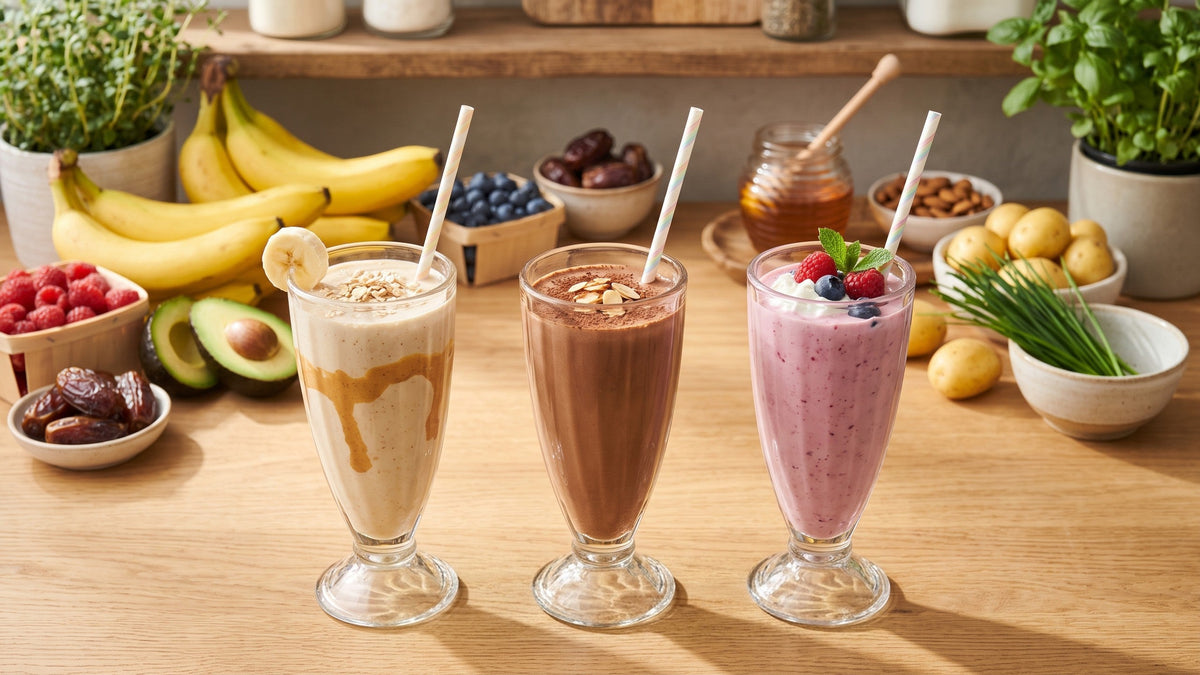
Yes, you can make high-calorie nutritional drinks yourself — and with ingredients found in almost every kitchen. The principle is always the same: a calorie-rich liquid base (whole milk, cream, oat or soy drink), plus carbohydrates (oats, banana, honey), fat (nut butter, avocado, oil) and protein (quark, skyr, yogurt). A homemade shake can deliver 400 to over 1,000 kcal in a glass — for around 1 to 2 euros. Here you will find the modular formula, seven calculated recipes, the cost per portion and an honest comparison: Where homemade shakes outperform store-bought nutritional drinks, and where their limits lie.
The most important things in brief
- The formula: Base + carbohydrates + fat + protein. If you choose one ingredient from each group, you will almost automatically end up with 500 to 700 kcal per shake.
- Fat is the calorie lever: 2 tablespoons of peanut butter provide around 190 kcal, 50 ml of cream about 150 kcal — more than a whole banana.
- Cost: Depending on the ingredients, a homemade shake costs around 1.00 to 1.80 euros — significantly less than powder or ready-to-drink products.
- The limits: Homemade shakes are not balanced (no defined amounts of vitamins and minerals), have a short shelf life, require more volume for the same calories — and in cases of disease-related malnutrition, nutrition belongs in medical hands.
Contents
- The modular formula: How to make every shake high-calorie
- 7 recipes for homemade nutritional drinks (400–1,000 kcal)
- All recipes at a glance: Calories, protein, costs
- The 5 limits of homemade nutritional drinks
- Homemade, powder or ready-to-drink? The comparison
- Practical tips: Preparation, shelf life, tolerability
- Frequently asked questions
The modular formula: How to make every shake high-calorie
Ready-made nutritional drinks are essentially nothing more than a highly concentrated mixture of carbohydrates, fat and protein in liquid — supplemented with vitamins and minerals. You can reproduce exactly this structure at home. The key is to choose at least one ingredient from each of the four groups. If you only mix fruit and water, you get a smoothie with 150 kcal. If you follow the formula, you get three to five times that.
| Building block | Ingredients (examples) | Calories per portion |
|---|---|---|
| 1. Base (liquid) | 250 ml whole milk (3.5%) · 250 ml oat or soy drink · 150 ml whole milk + 100 ml cream · 200 ml coconut milk | 115–390 kcal |
| 2. Carbohydrates | 40 g oats (150 kcal) · 1 banana (110 kcal) · 1 tbsp honey (60 kcal) · 2 dates (55 kcal) · 30 g maltodextrin (115 kcal) | 55–150 kcal |
| 3. Fat | 2 tbsp peanut or almond butter (190 kcal) · 50 ml cream (150 kcal) · ½ avocado (110 kcal) · 1 tbsp rapeseed or linseed oil (90 kcal) | 90–190 kcal |
| 4. Protein | 150 g 40% cream quark (240 kcal) · 150 g skyr (95 kcal) · 150 g cream yogurt (170 kcal) · 30 g skimmed milk powder (110 kcal) | 95–240 kcal |
An example to calculate: 250 ml whole milk (160 kcal) + 40 g oats (150 kcal) + 2 tbsp peanut butter (190 kcal) + 1 banana (110 kcal) = 610 kcal in one glass — about as much as a medium warm meal. Which ingredients deliver particularly much energy in little volume is shown in our large table of high-calorie foods.

7 recipes for homemade nutritional drinks (400–1,000 kcal)
All recipes make one portion of about 350 to 450 ml. The calorie figures are rounded approximate values based on common nutritional databases; depending on the brand and ripeness of the ingredients they vary slightly. Preparation is the same everywhere: put everything in the blender, mix on high for 30 to 60 seconds until creamy. Oats become finer if they soak in the milk for five minutes beforehand.
1. The classic: Banana-Oat-Peanut
- 250 ml whole milk (3.5%)
- 1 ripe banana
- 40 g fine oats
- 2 tbsp peanut butter (approx. 30 g)
- 1 tbsp honey
Why it works: The banana provides sweetness and carbohydrates, the peanut butter almost 200 kcal of good fat, and the oats make it filling and creamy. This recipe is the one almost everyone starts with — and the one most people stick with.
2. Chocolate-Avocado Shake
- 250 ml whole milk
- ½ ripe avocado
- 1 banana
- 1 tbsp baking cocoa (unsweetened)
- 2 tbsp almond butter
- 1 tbsp honey or maple syrup
Why it works: You can't taste the avocado in the shake, but it makes it unusually creamy and brings 110 kcal of unsaturated fatty acids. With cocoa it becomes a chocolate dessert to drink.
3. Berry-Quark Shake with Cream
- 150 g cream quark (40% fat in the product)
- 100 ml whole milk
- 50 ml whipping cream
- 100 g berries (fresh or frozen)
- 20 g oats
- 1 tbsp honey
Why it works: Quark and cream together provide almost 400 kcal and over 20 g of protein. The berries bring acidity and freshness — ideal for those who find sweet shakes quickly too overpowering.

4. Coffee Breakfast Shake
- 200 ml whole milk
- 50 ml whipping cream
- 1 espresso or 50 ml strong coffee (cooled)
- 40 g oats
- 1 tbsp nut-nougat cream
- ½ banana
Why it works: For everyone who can't manage a bite in the morning but drinks coffee. The shake replaces the breakfast that would otherwise be skipped — and delivers more energy than two buttered bread rolls.
5. Vegan Oat-Almond Shake
- 250 ml oat drink (barista quality, higher fat content)
- 2 tbsp almond butter
- 1 banana
- 40 g oats
- 2 pitted dates
- 1 tsp linseed oil
Why it works: Without dairy products, the simplest calorie source is missing — almond butter, dates and a teaspoon of linseed oil make up for it. For more protein 2 tbsp of soy yogurt or a spoonful of plant-based protein powder can be added.
6. Hearty Potato-Parmesan Drink (warm)
- 150 ml whole milk
- 100 ml whipping cream
- 100 g cooked potatoes (from the day before)
- 30 g Parmesan, grated
- 1 tbsp olive oil
- Salt, nutmeg, some chives
Why it works: Not everyone likes sweet — especially older people are more likely to reach for a cream soup than a banana shake. Warm everything together (do not boil), blend, and drink from the mug. More ideas for relatives are in the post about nutritional drinks for seniors.

7. The 1,000-kcal Gainer
- 300 ml whole milk
- 150 g cream quark (40% fat in the product)
- 60 g oats
- 1 banana
- 3 tbsp peanut butter (approx. 40 g)
- 1 tbsp honey
Why it works: The homemade answer to the weight gainer from the fitness shelf — with the same principle: lots of oats, lots of milk protein, lots of fat. Important: A shake of this size is a full meal and should not be drunk in addition to a large portion, but as its own meal. If appetite is small, it is better to divide two halves over the day.
All recipes at a glance: Calories, protein, costs
The costs are approximate values for supermarket ingredients (as of September 2026), calculated for one portion. Organic products or branded nut butters are correspondingly higher.
| Recipe | kcal per portion | Protein | Cost | Suitable for |
|---|---|---|---|---|
| 1. Banana-Oat-Peanut | approx. 670 | approx. 22 g | approx. €1.00 | Beginners, everyday |
| 2. Chocolate-Avocado | approx. 660 | approx. 16 g | approx. €1.50 | Dessert replacement, evening |
| 3. Berry-Quark-Cream | approx. 630 | approx. 22 g | approx. €1.40 | those who like it less sweet |
| 4. Coffee Breakfast | approx. 600 | approx. 15 g | approx. €1.20 | Breakfast grumps |
| 5. Vegan Oat-Almond | approx. 660 | approx. 14 g | approx. €1.60 | vegan, lactose-free |
| 6. Potato-Parmesan (warm) | approx. 670 | approx. 20 g | approx. €1.50 | hearty, seniors |
| 7. 1,000-kcal Gainer | approx. 1,080 | approx. 38 g | approx. €1.80 | Meal replacement, sports |
How many of these shakes you need per day depends on the total requirement: Usually, there is a surplus of about 300 to 500 kcal above the daily requirement — so one shake in addition to normal meals is usually enough. Our calorie requirement calculator shows your own requirement in two minutes.
The 5 limits of homemade nutritional drinks
Homemade shakes are affordable, fresh and taste like real ingredients. Nevertheless there are five points where they are inferior to store-bought nutritional drinks — and that you should know before relying on them for weeks.
- They are not balanced. Store-bought nutritional drinks contain defined amounts of vitamins and minerals per portion. A banana-oat shake provides energy and protein, but no calculable micronutrient supply. If you get a large part of your calories from homemade shakes over weeks, you should pay attention to varied ingredients — or supplement with powder containing vitamins and minerals.
- They only last for hours. A freshly mixed shake with milk, banana and quark belongs in the refrigerator and should be drunk within 24 hours; banana and avocado discolor after a short time. Ready-made nutritional drinks are shelf-stable for months unopened, powder as well.
- They require more volume. For 600 kcal you mix around 400 ml. A ready-to-drink bottle of nutritional drink brings 300 kcal in 200 ml — double the energy density. In cases of very small appetite, nausea or swallowing problems, this exact difference can decide whether the calories even arrive.
- They cost time and consistency. Five minutes per shake sounds like little — on day 30 it is the routine that fails, not the recipe. If you have to shop, prepare and wash, you are more likely to skip the shake than someone who stirs powder into milk.
- They are not therapy. In cases of disease-related malnutrition — for example after operations, with tumor diseases or chronic bowel diseases — the nutrition belongs in medical and nutritional therapy hands. For this, there are fully balanced nutritional drinks that can be prescribed by doctors. When the health insurance pays is stated in the post Nutritional drinks on prescription.
Important: If you are losing weight unintentionally, suffer from an illness or have difficulty swallowing, please seek medical advice before changing your diet to homemade shakes. The recipes here are intended for healthy people who want to gain weight.
Homemade, powder or ready-to-drink? An honest comparison
Three ways lead to a high-calorie drink — each with a different focus. The table calculates based on a typical serving: the banana-oat-peanut shake above, a 50-g serving of calorie powder in 250 ml whole milk and a 200-ml bottle of ready-to-drink medical food.
| Criterion | Homemade | Powder (e.g. CaloVital) | Ready-to-drink (e.g. CaloDrink) |
|---|---|---|---|
| Calories per serving | approx. 670 kcal (400 ml) | approx. 354 kcal (300 ml, with whole milk) | 300 kcal (200 ml) |
| Energy density | approx. 1.7 kcal/ml | approx. 1.2 kcal/ml | 1.5 kcal/ml |
| Vitamins & minerals | only from the ingredients, not defined | 12 vitamins, 9 minerals per serving | fully balanced (14 vitamins, 14 minerals) |
| Cost per serving | approx. €1.00–1.80 | approx. €2.20–2.70 incl. milk | approx. €2.70–5.00 per bottle |
| Cost per 100 kcal | approx. €0.15–0.25 | approx. €0.60–0.75 | approx. €0.90–1.65 |
| Shelf life | Hours (refrigerated max. 1 day) | Months (stored dry) | Months (unopened) |
| Effort | 5–10 minutes, blender, shopping | 1 minute, shaker | Open bottle |
| Prescribable by a doctor | No | No (PZN in the pharmacy) | Yes, for disease-related malnutrition (§ 31 SGB V) |
Conclusion from the table: When it comes to price per calorie, the homemade shake is the clear winner — it costs only a fraction. Powder scores points for shelf life, vitamins and minerals and one minute of preparation; ready-to-drink products offer the highest density in the smallest volume and the option of a medical prescription. Which powders and ready-made products are available and what to look for when buying is explained in the buying guide for weight-gain shakes.
The middle ground: Powder in the homemade shake
In practice, many combine both: You mix your favorite shake from fresh ingredients and stir in one scoop of calorie powder. One scoop (25 g) provides around 100 additional kcal — and also some of the vitamins and minerals that the purely homemade version lacks. With a flavor-neutral variety, the taste of the recipe is preserved; vanilla suits almost all sweet varieties. This turns the 670-kcal classic into a 770-kcal shake without making the glass fuller.
Calorie powder for the blender
CaloVital: 388 kcal per 100 g · 12 vitamins and 9 minerals · 20 flavors including flavor-neutral · made in Germany · available with a PZN in every pharmacy for order
To medical foodWant to test it first? The sample pack contains individual 50-g portion bags — also as a vegan variety.
Practical tips: Preparation, shelf life, tolerance
- Order in the blender: First liquid, then soft ingredients (banana, quark, nut butter), finally oats and ice. This prevents anything from sticking to the bottom.
- Soak oats: Five minutes in the milk, then they become creamy instead of grainy. Fine oats or instant oats dissolve even better.
- Not ice-cold, not too fast: Very cold, large quantities strain the stomach. At room temperature or slightly chilled and drunk over 10 to 15 minutes, a shake is significantly easier to tolerate.
- Between meals, not before: A shake right before lunch dampens the appetite for the actual meal. Better in the morning, afternoon or as a late meal — why an evening shake in particular makes sense is explained in the post Gaining weight in your sleep.
- Prepare instead of mixing daily: Dry ingredients (oats, cocoa, skim milk powder, chopped nuts) can be portioned into jars for a week. In the morning just add milk and banana.
- Freeze in portions: Shakes with milk, banana and nut butter can be stored frozen; quark and yogurt become grainy after thawing — so it's better to add them fresh.
- Dose sweetness: Ripe bananas and dates are intensely sweet; add honey only after tasting. A splash of lemon makes very sweet shakes fresher.
- Choose a small drinking vessel: A large glass of 450 ml can be off-putting. Two small glasses at one-hour intervals are easier for many to manage.

Frequently asked questions about homemade medical food
How can I make high-calorie medical food myself?
Using the building block formula: a calorie-rich base (250 ml whole milk or plant-based drink), carbohydrates (40 g oats, 1 banana, 1 tbsp honey), fat (2 tbsp nut butter, 50 ml cream or ½ avocado) and protein (150 g quark, skyr or yogurt). Mix everything in the blender creamy for 30 to 60 seconds — this results in 500 to 700 kcal per serving depending on the ingredients.
How many calories does a homemade weight-gain shake have?
A shake according to the formula Base + Carbohydrates + Fat + Protein provides about 600 to 700 kcal per serving — for example 250 ml whole milk, 40 g oats, 1 banana and 2 tbsp peanut butter with around 670 kcal. With additional quark, more nut butter and oats, over 1,000 kcal are possible in a shake.
How much does homemade medical food cost compared to store-bought?
A homemade shake with supermarket ingredients costs about €1.00 to 1.80 per serving, so around €0.15 to 0.25 per 100 kcal. Calorie powder including milk is about €2.20 to €2.70 per serving (0.60 to 0.75 euros per 100 kcal), ready-to-drink medical food is 2.70 to 5.00 euros per 200-ml bottle (0.90 to 1.65 euros per 100 kcal).
Is homemade medical food just as good as store-bought?
In terms of calories, protein and price, yes — often even better. Store-bought medical food has three advantages: It is balanced (defined vitamins and minerals per serving), lasts for months and provides more calories in less volume. For disease-related malnutrition fully balanced medical food is the medically recommended way; homemade shakes are intended for healthy people who want to gain weight.
Can I make medical food myself without milk or vegan?
Yes. Oat or soy drink is suitable as a base (barista varieties have more fat), as calorie sources almond or peanut butter, dates, banana, oats and a teaspoon of flaxseed oil. Soy yogurt or a plant-based protein powder help with more protein. Such a shake comes to about 650 kcal.
How long does homemade medical food last?
Freshly mixed, a shake with milk, banana or quark should be drunk chilled within 24 hours ; banana and avocado discolor after just a few hours. For storage shakes without quark and yogurt can be frozen in portions or the dry ingredients pre-portioned for a week.
The best shake is the one you really drink every day. Choose two favorites from the seven recipes, prepare the dry ingredients for the week — and make the shake a firm part of your day. How this becomes a complete plan with calorie requirements, meal structure and progress monitoring is shown in the comprehensive guide to weight gain.
- Max Rubner Institute (MRI): German Food Key (BLS) – German nutrient database. Accessed on 18.10.2026. blsdb.de
- U.S. Department of Agriculture (USDA), Agricultural Research Service: FoodData Central. Accessed on 18.10.2026. fdc.nal.usda.gov
- German Nutrition Society (DGE), Austrian Nutrition Society (ÖGE): Reference values for nutrient intake – Energy (guidelines for daily energy intake). Accessed on 18.10.2026. dge.de
- § 31 Para. 5 Social Code Book Five (SGB V) – Entitlement to balanced diets for enteral nutrition. Accessed on 18.10.2026. gesetze-im-internet.de
- Product information CaloVital and CaloDrink Vanilla: Labels. Price information: Editorial estimates, as of September 2026.
The mentioned laws, guidelines, specialist publications and databases concern nutrition and supply in general, not CaloDrink or other CaloShop products themselves. Product information on CaloShop products is excluded; it comes from their labels and nutritional information.
All calorie and protein information are rounded approximate values, calculated on the basis of common nutrient databases (German Food Key, USDA FoodData Central) and typical manufacturer information; depending on the product, brand and ripeness, the values may vary. Price information are estimates for supermarket ingredients (as of September 2026). The mentioned surplus of about 300 to 500 kcal is a common practical guideline, not a specification of a professional society; the daily requirements are described by the reference values of the German Nutrition Society (DGE). This post serves for general information and does not replace medical or nutritional therapy advice — in case of unintentional weight loss, illnesses or difficulty swallowing, please seek medical advice. As of: September 2026.


 Vorkasse – Banküberweisung