
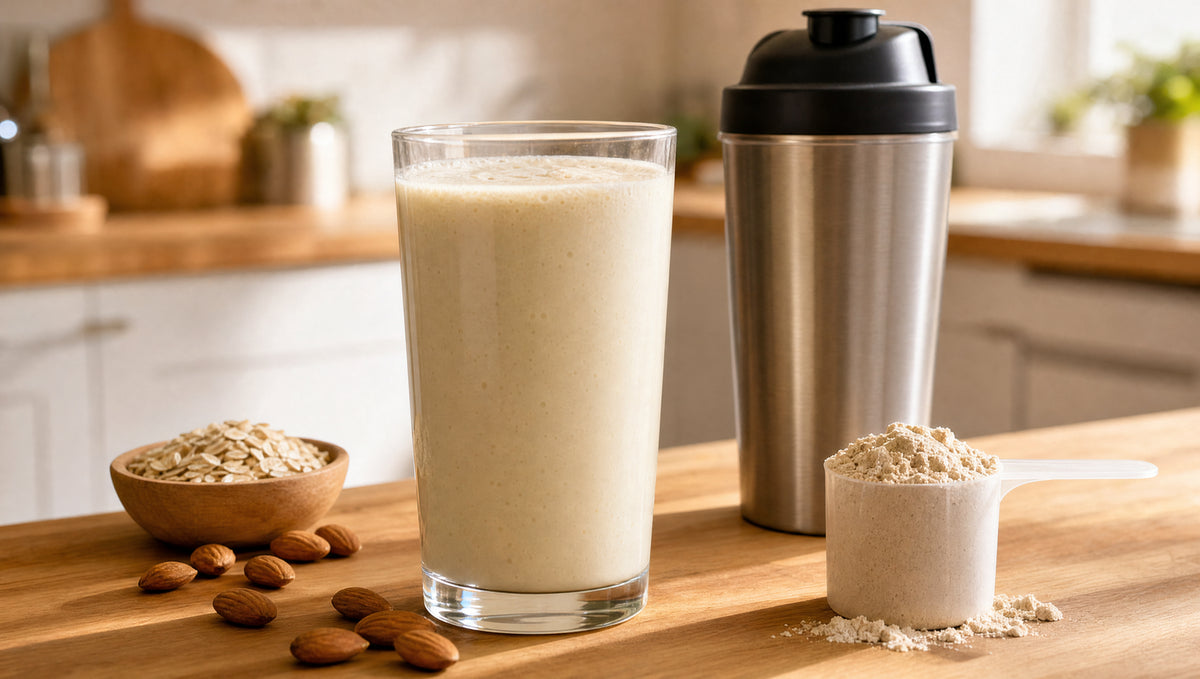
A shake for weight gain is a high-energy-density drink – usually 300 to 600 kcal per serving –, which is consumed in addition to regular meals to achieve a calorie surplus. Three product categories are available: sports weight gainers, high-calorie nutritional drinks in powder form (calorie shake), and ready-to-drink balanced nutritional drinks from the pharmacy. Which one is right for you depends on the reason for gaining weight, your budget, and tolerability – this guide breaks it down.
The short version
- For healthy weight gain with a poor appetite, after illness, or as a "hardgainer": high-calorie drink powder such as CaloVital – 194 kcal per 50-g serving with water, around 354 kcal with whole milk, plus 12 vitamins and 9 minerals, from approx. €1.67 per serving.
- For illness-related malnutrition, chewing or swallowing difficulties: ready-to-drink, fully balanced nutritional drinks such as CaloDrink (300 kcal per 200-ml bottle) – available by prescription.
- For muscle building with training: high-protein variants such as CaloDrink+ (25 g protein per 100 g, with creatine) or classic weight gainers.
- Rule of thumb: 300–500 kcal daily above requirements – that is one to two additional shakes. The calculator provides the requirements: Calorie Requirement Calculator.
Weight gainer, calorie shake, or nutritional drink – what is the difference?
The three terms are often used interchangeably, but refer to different products with different purposes:
| Feature | Weight gainer (sports) | Calorie shake powder (nutritional drink) | Ready-to-drink balanced nutritional drink |
|---|---|---|---|
| Typical serving | 100–150 g powder, 400–600 kcal | 50 g powder, 190–380 kcal (depending on liquid) | 200-ml bottle, 300 kcal (1.5 kcal/ml) |
| Target group | Strength athletes with high training volume | Underweight, poor appetite, convalescence, seniors, hardgainers | Illness-related malnutrition, care, chewing/swallowing difficulties |
| Nutrient profile | Carbohydrates plus protein, usually low in micronutrients | Carbohydrates, protein, fat plus vitamins and minerals | Fully balanced – all nutrients in defined amounts, suitable for exclusive nutrition |
| Legal status | Food / sports nutrition | Food (high-calorie drink powder) | Food for special medical purposes (balanced diet), under medical supervision |
| Health insurance | No | No (orderable by PZN in the pharmacy) | Yes, for illness-related malnutrition by prescription (§ 31 SGB V) |
| Cost per 100 kcal | Depending on the brand | Approx. €0.47–0.86 (CaloVital) | Approx. €0.90 (CaloDrink, 24-pack) |
| Examples at CaloShop | CaloDrink+ (high-protein, with creatine) | CaloVital, CaloVital Vegan, CaloSleep, CaloKids | CaloDrink Vanilla |
How many calories do you need in a shake for weight gain?
The decisive factor is not the shake alone, but the daily balance. As a rule of thumb, a surplus of 300 to 500 kcal daily above the total requirement is recommended; this corresponds to approximately 0.25 to 0.5 kg of weight gain per week (one kilogram of body fat corresponds roughly to 7,000 kcal). A larger surplus hardly accelerates weight gain, but mostly ends up as fat tissue.
- Determine requirements. Basal metabolic rate according to Mifflin-St Jeor plus activity factor – the calculator does this in ten seconds. Example: Woman, 68 years, 160 cm, 48 kg, slightly active → approx. 1,400 kcal total requirement.
- Estimate current intake. Those who are losing weight are below this. Roughly record what is eaten for three days.
- Close the gap with shakes. If 400 kcal are missing, one glass of CaloVital with whole milk (354 kcal) plus a piece of fruit – or a bottle of CaloDrink (300 kcal) between meals is enough.
- Weigh weekly, in the morning on an empty stomach. If the weight does not increase after two weeks, plan in another serving.
What to look for when buying – 8 criteria
- Calories per serving, not per 100 g. 388 kcal per 100 g sounds like a lot – the decisive factor is the actual serving: 50 g of CaloVital in water = 194 kcal, in 250 ml of whole milk = approx. 354 kcal.
- Price per 100 kcal. The most honest comparison measure. Package price ÷ servings ÷ kcal per serving × 100. Example CaloVital 3-kg bag: €99.95 ÷ 60 servings = €1.67 per serving = €0.86 per 100 kcal (with water).
- Protein content. To maintain muscle mass, each serving should contain 8–15 g of protein; adding milk brings another approx. 8 g. For muscle building with training, it can be more (CaloDrink+: 12.5 g per 50 g of powder).
- Sugar. Fast carbohydrates provide energy, but should not be the only source. CaloDrink+ comes with 4.7 g of sugar per 100 g, CaloVital contains 35 g per 100 g.
- Vitamins and minerals. Those who eat little also take in few micronutrients. A shake with 12 vitamins and 9 minerals (CaloVital: 30–40% of the reference amount per 100 g) closes this gap.
- Tolerability. Lactose intolerance → vegan or lactose-free variant (CaloVital Vegan) or low-lactose nutritional drink (CaloDrink, 0.19 g per 100 ml); gluten intolerance → gluten-free products; diabetes → consult your doctor.
- Taste and variety. A shake that no longer tastes good after two weeks will not be drunk anymore. 20 flavors and a sample pack (€4.49 per serving pouch) reduce the risk.
- Origin and traceability. Manufactured in Germany, complete nutritional declaration, and a pharmaceutical central number (PZN) – this makes the product orderable via the pharmacy as well.
Price comparison per 100 kcal: the CaloShop products
| Product | Serving | kcal per serving | Price per serving | Price per 100 kcal |
|---|---|---|---|---|
| CaloVital, 3-kg bag | 50 g + 250 ml whole milk | approx. 354 | €1.67 (+ milk) | approx. €0.47 |
| CaloVital, 500 g | 50 g + 250 ml whole milk | approx. 354 | €1.90–2.40 (+ milk) | approx. €0.54–0.68 |
| CaloVital, 500 g | 50 g + water | 194 | €1.90–2.40 | approx. €0.98–1.24 |
| CaloDrink+ Strawberry, 500 g | 50 g + 250 ml whole milk | approx. 379 | €2.50 (+ milk) | approx. €0.66 |
| CaloDrink Vanilla, 24-pack | 200-ml bottle | 300 | €2.71 | approx. €0.90 |
| CaloSoup, 500 g | 25 g + 250 ml whole milk | 275 | €0.95–1.00 (+ milk) | approx. €0.35 |
| CaloCake, 24-pack | 1 bar (125 g) | up to 592 | €1.87 | approx. €0.32 |
Prices as of August 23, 2026, incl. VAT; whole milk (3.5%) provides around 64 kcal per 100 ml and is not included.
Make a shake for weight gain yourself – or buy one?
A homemade shake is affordable and fresh: 250 ml whole milk (approx. 160 kcal), one banana (approx. 105 kcal), 2 tbsp oats (approx. 75 kcal), and 1 tbsp peanut butter (approx. 90 kcal) yield around 430 kcal for about €1. The limitations become apparent in everyday life: The shake must be freshly prepared every time, the nutrients vary, vitamins and minerals are not balanced, and those who need to gain weight due to loss of appetite or illness often cannot manage the volume. Nutritional drink powder solves exactly this: 50 g of powder provides the same energy as the large homemade mix in 250 ml, plus defined micronutrients – and can also be stirred into yogurt, porridge, or soup. A good strategy is to combine them: homemade mix in the morning, nutritional drink in the afternoon and evening.
The most common mistakes when gaining weight with shakes
- The shake replaces a meal – instead of complementing it. Then the balance remains the same.
- Portions that are too large at once. Two small shakes between meals are better tolerated than one liter in the evening.
- Only mixed with water. Whole milk, oat or soy drinks provide an additional 100–160 kcal per serving.
- No monitoring. Without weekly weighing, you won't notice if the surplus is too small.
- Waiting too long when ill. Unintentional weight loss of more than 5% in three months should be addressed by a doctor – then balanced nutritional drink on prescription is the right way.
When to see a doctor? Unintentional weight loss, loss of appetite for weeks, swallowing difficulties, or a BMI below 18.5 should be medically examined. If illness-related malnutrition exists or is imminent, the doctor can prescribe fully balanced nutritional drinks such as CaloDrink Vanilla on a prescription (Form 16) – without an application, with a co-payment of €5–10 per package. More on this: With prescription, without prescription, via the pharmacy.
Try first, then decide
The CaloVital sample pack provides 20 flavors as 50-g serving pouches for €4.49 per pouch – free shipping within Germany, delivery in 1–3 business days.
View sample pack Nutritional drinks comparisonFrequently asked questions about shakes for weight gain
Which shake is best for weight gain?
The best shake is the one you drink daily: enough calories per serving (300 kcal or more), protein, vitamins and minerals, a flavor that lasts for weeks, and a price per 100 kcal that fits your budget. For healthy weight gain without a prescription, CaloVital (powder, 20 flavors, from €0.47 per 100 kcal with whole milk) meets these criteria; for illness-related malnutrition, ready-to-drink, fully balanced nutritional drinks such as CaloDrink are the right choice.
How many shakes per day for weight gain?
One to two shakes in addition to regular meals cover a surplus of 300–500 kcal. When using nutritional drinks as a supplement, 1–3 bottles daily are considered usual; powders such as CaloVital are dosed at 2–5 servings per day. Important: The shake complements the meal, it does not replace it.
How quickly do you gain weight with shakes?
With a daily surplus of 300–500 kcal, 0.25–0.5 kg per week is realistically calculated, so 1–2 kg per month. After an illness, it often goes faster at first because fluid and glycogen are replenished. Weigh weekly and adjust the servings.
Is a weight gainer the same as a nutritional drink?
No. Weight gainers are sports nutrition with large servings (100–150 g) of carbohydrates and protein, usually without balanced micronutrients. Nutritional drinks provide energy in smaller servings plus vitamins and minerals; fully balanced nutritional drinks (balanced diet) can even replace the entire diet and are available on prescription.
Are there shakes for weight gain available on prescription?
Yes – fully balanced nutritional drinks such as CaloDrink Vanilla, Fortimel, or Fresubin are covered by statutory health insurance for illness-related malnutrition (§ 31 SGB V). The doctor prescribes them on a prescription Form 16 with a PZN; the co-payment is 10%, at least €5 and at most €10 per package. Powders such as CaloVital are not covered by prescription, but can be ordered by PZN in any pharmacy.
Which shake for weight gain is vegan or lactose-free?
CaloVital Vegan is vegan, lactose-free, and gluten-free (pea protein, 195–199 kcal per serving with water). CaloDrink is low in lactose (0.19 g per 100 ml) and gluten-free. CaloSoup consists of purely plant-based ingredients. All powders can be prepared with oat, soy, or almond drinks.
- Mifflin MD, St Jeor ST, Hill LA et al. (1990): A new predictive equation for resting energy expenditure in healthy individuals. American Journal of Clinical Nutrition 51(2):241–247. doi:10.1093/ajcn/51.2.241 pubmed.ncbi.nlm.nih.gov
- Regulation (EU) No. 1169/2011 on the provision of food information to consumers (FIC), Annex XIII Part A: Nutrient Reference Values (NRV, "reference amount"). OJ L 304 of 22.11.2011, p. 18. eur-lex.europa.eu
- Social Security Code (SGB) Fifth Book (V) – Statutory Health Insurance, § 31 Medicines and Medical Supplies, Authorization to Prescribe (especially para. 5: Claim to balanced diets for enteral nutrition). Online at gesetze-im-internet.de, accessed 18.10.2026. gesetze-im-internet.de
- § 61 Sentence 1 SGB V – Co-payments: 10 percent of the dispensing price, at least 5 euros, at most 10 euros. Accessed on 18.10.2026. gesetze-im-internet.de
- Federal Joint Committee (G-BA) (version of 22 January 2009, last amended 16 July 2026, in force since 3 October 2026): Guideline on the prescription of medicinal products in contract medical care (Medicinal Products Guideline, AM-RL), Section I (§§ 18 to 26): Balanced diets for enteral nutrition. Online, accessed 18 October 2026. g-ba.de
- Nutritional and pricing information for CaloShop products according to the product pages, as of 23 August 2026.
The laws, guidelines, specialist publications and databases mentioned relate to nutrition and care in general, not to CaloDrink or other CaloShop products themselves. Product information for CaloShop products is excluded; it is taken from their labels and nutritional information.
This article is for general information purposes only and is not a substitute for medical advice. CaloDrink Vanilla is a food for special medical purposes and should only be used under medical supervision.


 Vorkasse – Banküberweisung