
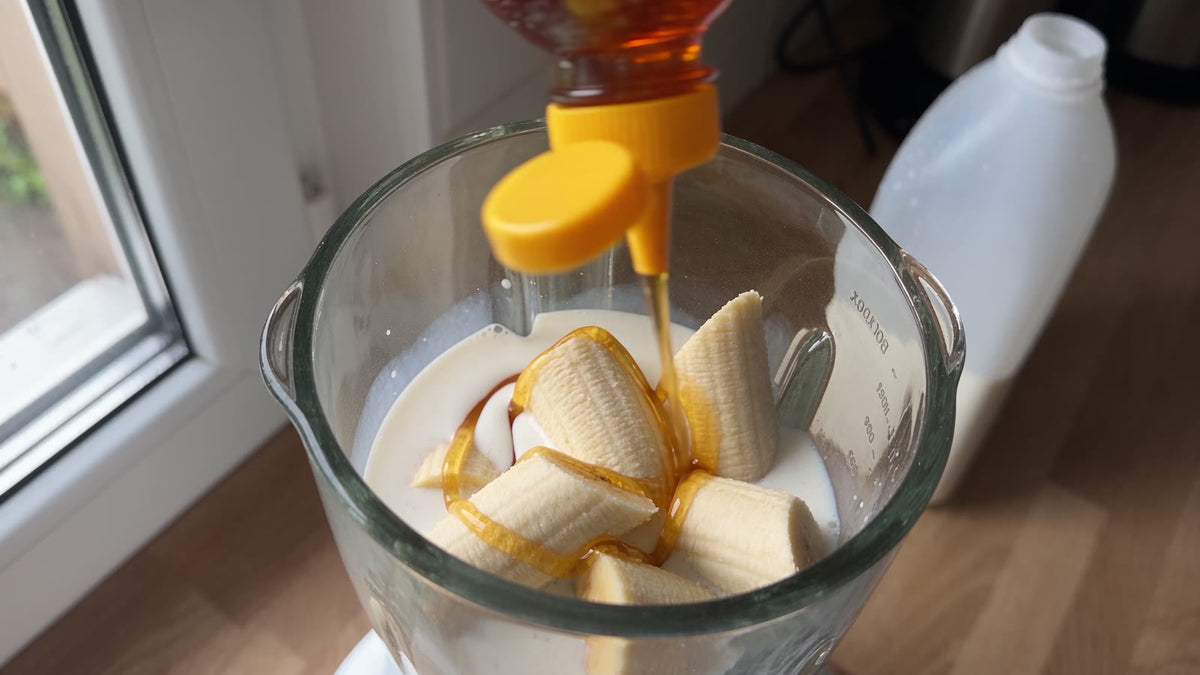
Video: AI-animated depiction of preparation; recipe, quantities and nutritional values are calculated based on real data.
A mass shake with 2,060 kcal and 57 g of protein in a single glass needs no special ingredients: 400 ml whole milk, 200 g cream, 100 g CaloVital chocolate, 100 g peanut butter, one banana and two tablespoons of honey, 60 seconds in the blender. That is as much energy as a whole day's worth of food for many people. That is exactly what it is designed for: for anyone who wants to gain weight or has to, and who simply cannot eat any more. Here you will find the recipe from our video, the nutritional values of each individual ingredient, all the vitamins and minerals in the glass, the cost and the honest answer as to who such a shake is suitable for and who it is not.
The most important things in brief
- One glass, 972 g: 2,060 kcal, 57 g protein, 130 g fat, 149 g carbohydrates. Calculated from all six ingredients, not estimated.
- Fat is the main calorie driver: Cream and peanut butter together provide around 1,200 kcal, so more than half of the glass.
- Vitamins and minerals: Vitamin E, niacin, B12, manganese, B6, vitamin A, calcium and folic acid each exceed 100% of the daily reference intake (NRV).
- In addition, not instead of: The shake does not replace a meal; it is on top of it. It is best split into two halves throughout the day.
- Too much? Halve everything. The ratio remains the same, so it is around 1,030 kcal.
Contents
- The recipe: 6 ingredients, a blender, 60 seconds
- Where the 2,060 calories come from: each ingredient individually
- Vitamins and minerals in the glass
- Who the shake is designed for and who it is not
- Variants: half portion, without peanuts, lactose-free, more protein
- What the glass costs
- How to incorporate the shake into your day
- Frequently asked questions
The recipe: 6 ingredients, a blender, 60 seconds
Chocolate-peanut mass shake with CaloVital
- 400 ml whole milk (3.5% fat)
- 200 g whipping cream (30% fat)
- 100 g CaloVital chocolate (4 heaped measuring spoons)
- 100 g peanut butter (without added sugar)
- 1 ripe banana (approx. 120 g peeled)
- 2 tbsp honey (approx. 40 g)
Why it works: The milk is only the base. Cream and peanut butter provide the fat and thus most of the calories, the calorie powder provides carbohydrates, protein and vitamins, and the banana and honey make it sweet and creamy. All together, it drinks like a thick chocolate milkshake, not like a powdered drink.
- Liquids first. Pour the milk and cream into the blender. This prevents the powder from sticking to the bottom and allows the blades to spin freely immediately.
- Add the powder and peanut butter. Sprinkle in the CaloVital chocolate, then add the peanut butter spoon by spoon. If the butter is very firm, hold the spoon under hot water for a moment.
- Banana and honey. Break the banana into pieces, and add the honey last so it does not stick to the bottom of the blender.
- Blend for 60 seconds. Start on low speed, then increase to high until nothing is chunky and the surface is smooth and shiny. Add four ice cubes for a colder shake.
- Drink immediately or share. The whole blender jar is one glass of around 970 g. If you cannot finish it all at once, refrigerate half and drink it in the afternoon.
Where the 2,060 calories come from: each ingredient individually
Most shake recipes online state a number rather than showing the calculation. Here is the calculation. The values for each ingredient come from the USDA FoodData Central nutritional database and typical German label information (cream 30%, whole milk 3.5%), while the values for CaloVital chocolate come from the product label. All figures have been rounded to the nearest whole kcal.
| Ingredient | Quantity | Calories | Protein | Share of the glass |
|---|---|---|---|---|
| Cream 30% | 200 g | 600 kcal | 6 g | 29% |
| Peanut butter | 100 g | 598 kcal | 22 g | 29% |
| CaloVital chocolate | 100 g | 382 kcal | 15 g | 19% |
| Whole milk 3.5% | 400 ml | 251 kcal | 13 g | 12% |
| Honey | 40 g | 122 kcal | 0 g | 6% |
| Banana | 120 g | 107 kcal | 1 g | 5% |
| Total (1 glass) | 972 g | 2,060 kcal | 57 g | 100% |
Two things stand out in the table. First: cream and peanut butter are the calorie engine. Together they provide almost 1,200 kcal, or 58% of the glass, although they only make up 300 g of the 972 g. Fat has more than twice the energy of carbohydrates and protein at 9 kcal per gram, which is why 100 g of peanut butter contains as much as five bananas. Second: The protein content is high at 57 g, but the shake is not a protein shake. Protein provides around 11% of the energy, while the rest comes from fat (57%) and carbohydrates (29%). If you are mainly looking for protein, you are better off with a quark shake; if you are looking for calories, you have come to the right place. Which foods provide particularly high energy in a small volume is shown in our extensive table of high-calorie foods.

Vitamins and minerals in the glass
The difference from a pure cream-peanut shake lies in the powder: CaloVital contains 12 vitamins with 40% each and 9 minerals with 30% each of the daily reference intake (NRV) per 100 g. In addition, there are the micronutrients from milk, cream, peanut butter, banana, and honey. The balance for the whole glass: eight nutrients exceed 100% of the daily reference intake (vitamin E 135%, niacin 127%, vitamin B12 127%, manganese 124%, vitamin B6 119%, vitamin A 118%, potassium 117%, calcium 112%), with another eleven between 40 and 110%. The complete list is available in the expandable block.
Show all 19 vitamins and minerals in the glass
Calculated from all six ingredients, based on the whole glass (972 g, 2,060 kcal). Sorted by share of the daily reference intake.
| Nutrient | % of the daily reference intake (NRV) per glass | Main sources in the shake |
|---|---|---|
| Vitamin E | 135% | Peanut butter, CaloVital |
| Niacin (B3) | 127% | Peanut butter, CaloVital |
| Vitamin B12 | 127% | Milk, cream, CaloVital |
| Manganese | 124% | Peanut butter, banana, CaloVital |
| Vitamin B6 | 119% | Banana, peanut butter, CaloVital |
| Vitamin A | 118% | Cream, CaloVital |
| Potassium | 117% | Milk, banana, peanut butter, CaloVital |
| Calcium | 112% | Milk, cream, CaloVital |
| Folic acid | 110% | Peanut butter, CaloVital |
| Vitamin B2 | 99% | Milk, cream, CaloVital |
| Magnesium | 98% | Peanut butter, milk, CaloVital |
| Copper | 95% | Peanut butter, CaloVital |
| Selenium | 79% | Milk, peanut butter, CaloVital |
| Zinc | 78% | Peanut butter, milk, CaloVital |
| Vitamin D | 72% | CaloVital, cream |
| Pantothenic acid (B5) | 65% | Milk, peanut butter, CaloVital |
| Vitamin C | 55% | CaloVital, banana |
| Iron | 48% | CaloVital, peanut butter |
| Biotin | 40% | CaloVital |
Important for context: These values are calculated, not measured in a laboratory, and apply to the whole glass of 2,060 kcal. If you drink half the portion, you also get half of the micronutrients. A homemade shake is also never as "balanced" as a ready-made medical food, where every bottle has exactly the same composition. What this means in practice is explained in the post Making Your Own Medical Food: 7 Recipes and Their Limitations.
Who the shake is designed for and who it is not
2,060 kcal in a glass is a lot. For some, this is exactly the solution, for others simply too much. Three groups for whom this recipe is designed:
- Hardgainers and athletes in the bulking phase, who need 3,500 kcal or more daily and cannot get enough from solid food. The shake is drinkable without feeling stuffed, and it provides one-third to half of the daily requirement.
- People with a small appetite, for whom large portions on the plate cause resistance. Drinking is easier for many than chewing, and a cold chocolate shake doesn't taste like "bulking food".
- Anyone who wants to gain weight quickly and predictably: A calorie surplus of 300 to 500 kcal per day results in around 1 to 2 kg per month. Half a portion of this shake covers this surplus on its own. How high your personal requirement is is shown by the Calorie Requirement Calculator.
Who the shake is not designed for: those with a peanut allergy (replace peanut butter with almond or cashew butter), lactose intolerance (see the lactose-free variant below), and children. If you are losing weight unintentionally due to an illness, you should have your diet checked by a doctor; fully balanced medical food is available for this, which can also be prescribed by a doctor in cases of illness-related malnutrition. And: 200 g of cream and 100 g of peanut butter daily is a lot of fat. The shake is a tool for a planned bulking phase, not a long-term solution without considering the rest of your diet.
Variants: half portion, without peanuts, lactose-free, more protein
The basic recipe is modular. If you swap an ingredient, you should know what happens with the calories and the nutritional values. The figures are approximate values per whole glass.
| Variant | What changes | Calories / protein per glass |
|---|---|---|
| Half portion | Halve all quantities, same ratio, results in approx. 485 g | approx. 1,030 kcal / 29 g |
| Vanilla instead of chocolate | CaloVital vanilla instead of chocolate, plus 1 tsp cinnamon; peanut butter remains | approx. 2,060 kcal / 57 g |
| Without peanuts | 100 g almond butter instead of peanut butter (approx. 615 kcal per 100 g) | approx. 2,080 kcal / 56 g |
| Lactose-free | Lactose-free whole milk and cream, CaloVital Vegan Chocolate instead of CaloVital | approx. 2,050 kcal / 55 g |
| Higher in protein | Add 200 g low-fat quark; reduce milk to 300 ml, otherwise it won't fit in the jug | approx. 2,130 kcal / 78 g |
| Lighter on the stomach | Reduce cream to 100 g, add 40 g oats instead; keeps you full more slowly, less fat | approx. 1,910 kcal / 60 g |

What the glass costs
A mass shake with 2,060 kcal is not a cheap recipe, but cheaper per calorie than almost every ready-made nutritional drink. The prices are estimates for supermarket ingredients (as of September 2026); CaloVital is calculated at the regular shop price of €23.95 per 500 g.
| Ingredient | Quantity | Cost (approx.) |
|---|---|---|
| CaloVital Chocolate | 100 g | €4.79 |
| Peanut butter | 100 g | €1.00 |
| Cream 30% | 200 g | €0.75 |
| Whole milk | 400 ml | €0.45 |
| Honey | 40 g | €0.35 |
| Banana | 1 piece | €0.25 |
| Total per glass | 2,060 kcal | approx. €7.60 |
That is around €0.37 per 100 kcal. For comparison: ready-made nutritional drinks from the pharmacy are estimated at €0.90 to €1.65 per 100 kcal depending on the brand, a simple homemade oat-banana shake at about €0.15 to €0.25. The mass shake is somewhere in between, because the powder makes up the largest item. If you mix it without powder, you save €4.79, but lose 382 kcal, 15 g of protein and all the vitamin and mineral content from the table above.
How the shake fits into the day
Timing: in two halves instead of all at once
A whole glass with 972 g at once is too much for most, even for experienced eaters. It has proven effective to split it: one half in the morning between breakfast and lunch, the second in the afternoon or after training. This way, the shake does not interfere with normal meals, and the stomach has time. If you want to add calories in the evening, you will find the suitable night variant in the post Gaining weight in your sleep.
Shelf life: 24 hours in the refrigerator
Once blended and sealed, the shake lasts one day in the refrigerator. The banana discolors it slightly brown after a few hours, but that is just cosmetic, not spoilage. Shake briefly before drinking, because the peanut butter settles a bit. Freezing is also possible: portioned as ice cubes and later blended into milk.
If the shake is too thick
With 200 g of cream and 100 g of peanut butter, it becomes very thick. If you prefer it thinner, replace 100 ml of the milk with water or add four ice cubes; the calories do not change as a result. A blender with at least 600 watts is useful; a shaker cannot handle the peanut butter.

Control: weigh, don't guess
If you want to gain weight, you should measure the result: once a week, in the morning, on an empty stomach, using the same scale. If the weight remains the same after three weeks, the surplus is not enough, then increase the half portion to a whole one. If it rises faster than half a kilo per week, rather go back to the half. The complete roadmap with requirements, meal structure, and typical mistakes is available in the comprehensive guide to weight gain.
CaloVital Chocolate: the powder from the recipe
382 kcal per 100 g, 12 vitamins and 9 minerals, made in Germany. The 500-g container lasts for five mass shakes or ten normal portions.
View CaloVitalFrequently asked questions about the mass shake
How many calories does the mass shake have?
A whole glass with 972 g has 2,060 kcal, 57 g of protein, 130 g of fat, and 149 g of carbohydrates. The number results from 400 ml of whole milk (251 kcal), 200 g of cream (600 kcal), 100 g of CaloVital Chocolate (382 kcal), 100 g of peanut butter (598 kcal), one banana (107 kcal), and 40 g of honey (122 kcal).
Can I drink the mass shake every day?
Yes, during a bulking phase, preferably as a half portion (around 1,030 kcal) in addition to normal meals and with weekly weight control. The whole glass daily is only useful for people with very high requirements, such as athletes with 3,500 kcal or more per day.
Is the shake a protein shake?
No. With 57 g of protein, it does contain a lot of it, but protein only provides around 11% of the energy; the majority comes from fat and carbohydrates. If you want mainly protein, add 200 g of low-fat quark to it (then around 78 g of protein) or opt for a quark shake.
Can the mass shake be made without powder?
Yes, with milk, cream, peanut butter, banana, and honey, it comes to around 1,680 kcal and 42 g of protein. It then lacks the 382 kcal, 15 g of protein, and the 12 vitamins and 9 minerals from the calorie powder. As a replacement for the calories, 60 g of oats are suitable (around 220 kcal).
Can I make the shake lactose-free or vegan?
Lactose-free: lactose-free whole milk and cream plus CaloVital Vegan Chocolate, which results in around 2,050 kcal. Vegan: barista oat drink instead of milk, 100 ml coconut milk instead of cream, and CaloVital Vegan; the shake then is around 1,750 kcal, because oat drink and coconut milk provide less energy than whole milk and cream.
How long does the finished shake last?
Sealed in the refrigerator for 24 hours. The banana discolors the shake slightly after a few hours, which is harmless. Shake before drinking, because the peanut butter settles. For storage, it can be frozen in portions.
The shake from the video is deliberately at the upper end of what fits in a glass. If you start with it, you should start small: the half portion, every day, for three weeks, then check the scale. That is the whole trick with gaining weight: not the one big shake, but the surplus that is there every day.
- U.S. Department of Agriculture (USDA), Agricultural Research Service: FoodData Central (whole milk, banana, honey, peanut butter). Accessed on 18.10.2026. fdc.nal.usda.gov
- Regulation (EU) No. 1169/2011 on the provision of food information to consumers (FIC), Annex XIII Part A: Nutrient Reference Values (NRV). OJ L 304 of 22.11.2011, p. 18. eur-lex.europa.eu
- Product information CaloVital Chocolate: label (382 kcal and 14.8 g of protein per 100 g). Cream and whole milk: typical German label values. Total values: own calculation, not measured in the laboratory. Prices: editorial estimates, as of September 2026.
The mentioned laws, guidelines, scientific publications, and databases concern nutrition and supply in general, not CaloDrink or other CaloShop products themselves. Product information on CaloShop products is excluded; it comes from their labels and nutritional information.
All calorie, protein, and micronutrient information are calculated, rounded approximate values based on USDA FoodData Central (whole milk, banana, honey, peanut butter), typical German label values (cream 30% fat, whole milk 3.5% fat, vitamin A and D from dairy products according to German values without fortification) and the label of CaloVital Chocolate (382 kcal and 14.8 g of protein per 100 g; 12 vitamins at 40% NRV, 9 minerals at 30% NRV per 100 g). Vitamin B1 and iodine are not listed due to uncertain data on the individual ingredients. NRV = reference amount for the daily intake according to the Food Information Regulation (FIC). Depending on the brand, ripeness, and fat content of the ingredients, the values may vary by a few percent. Prices are estimates for supermarket ingredients (as of September 2026). This post is for general information and does not replace medical or nutritional therapy advice; in case of unintentional weight loss, illness, allergies, or intolerances, please seek medical advice. As of: September 20, 2026.


 Vorkasse – Banküberweisung