
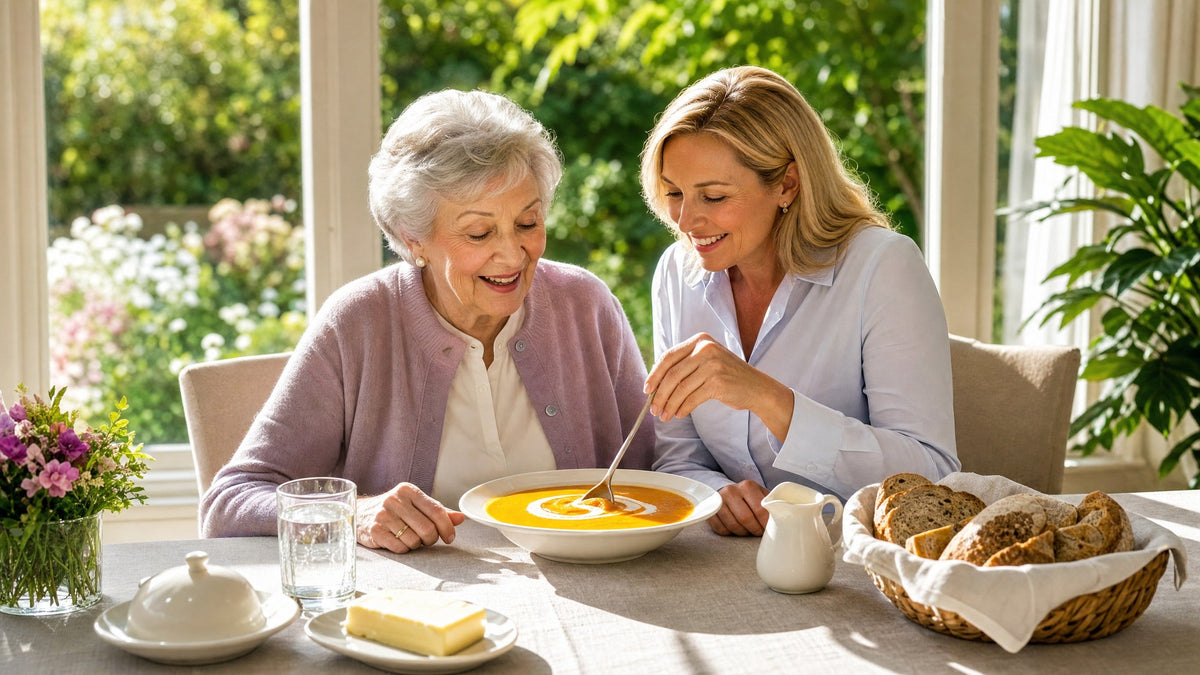
Food fortification means enhancing meals with energy-dense ingredients such as cream, butter, oil, nut butter, cheese, egg, and milk powder without increasing the portion size. One tablespoon of nut butter provides approx. 95 kcal, one tablespoon of oil approx. 90 kcal, and two tablespoons of cream approx. 90 kcal. Spread over five small meals, this adds up to around 600 extra calories a day, and the plate looks just like it always has.
This article is intended for family members caring for someone at home who is eating too little: after an illness, in old age, or due to dementia or chewing and swallowing problems. These 15 tricks work in any kitchen. If your loved one is losing weight unintentionally, please consult a doctor first to determine the cause.
The most important things in brief
- Fat is the most powerful lever: 9 kcal per gram, more than twice as much as protein or carbohydrates. Cream, butter, and oil disappear invisibly into soup, purée, and porridge.
- Don't forget protein: Egg, cheese, quark, nut butter, and milk powder provide energy and protein for the muscles.
- Small and frequent: Five to six small, fortified meals instead of three large plates.
- Finger food keeps people with dementia eating, even without cutlery and without having to stay seated.
- Calculation example: A normal care day with five small additions provides around 600 extra kcal.
- Limit: If fortification is not enough, oral nutritional supplements should be included in the medical plan.
Contents
- Why fortification is better than serving more
- The fortification table: calories per tablespoon
- 15 tricks for everyday care
- Calculation example: a care day with 600 extra kcal
- What doesn't help: five typical mistakes
- Checklist for family members
- When fortification is not enough
- Frequently asked questions from family members
Three figures for orientation:
Why fortification is better than serving more
Someone with little appetite won't eat more just because the plate is fuller. On the contrary: a large plate is off-putting, and they stop after a few bites. With fortification, the quantity remains the same, but the energy per bite increases. This is why professional societies call fortification one of the first measures.
The S3 guideline of the German Society for Nutritional Medicine (DGEM) on nutrition in old age recommends fortifying food and drinks with natural foods such as cream, oil, butter, and eggs, and adding maltodextrin and protein powder if necessary. The European professional society ESPEN recommends fortified meals and additional snacks for older people with malnutrition or a risk of it. The German Nutrition Society (DGE) advises several small meals throughout the day and energy-dense drinks for a small appetite.
In practice, this means: keep the favorite dishes, just change the ingredients. An overview of which foods provide particularly much energy in a small volume can be found in our table of high-calorie foods. How much energy your loved one actually needs is shown by the calorie requirement calculator.
The fortification table: calories per tablespoon
These 15 ingredients belong in every care kitchen. All values are rounded guidelines per usual portion and vary depending on the product.
| Ingredient | Quantity | approx. kcal | Pairs well with |
|---|---|---|---|
| Heavy cream (30% fat) | 2 tbsp (approx. 30 ml) | approx. 90 | Soup, sauce, porridge, cocoa, coffee |
| Nut butter (almond, peanut) | 1 tbsp (approx. 15 g) | approx. 95 | Oatmeal, quark, pudding, milk |
| Rapeseed or olive oil | 1 tbsp (approx. 10 g) | approx. 90 | Vegetables, potatoes, soup, salad |
| Mascarpone | 1 tbsp (approx. 20 g) | approx. 85 | Quark, fruit, pudding, cake |
| Egg (size M) | 1 piece (approx. 55 g) | approx. 85 | Purée, soup (whisked), casserole |
| Avocado | ½ small fruit (approx. 50 g) | approx. 80 | Bread spread, dip, purée |
| Butter | 1 tbsp (approx. 10 g) | approx. 75 | Purée, vegetables, bread, porridge |
| Double cream cream cheese | 1 tbsp (approx. 20 g) | approx. 70 | Bread (under the topping), sauce, dip |
| Ground nuts or almonds | 1 tbsp (approx. 10 g) | approx. 60 | Porridge, yogurt, compote, breading |
| Crème fraîche (30% fat) | 1 tbsp (approx. 20 g) | approx. 60 | Soup, sauce, potatoes |
| Coconut milk (can) | 2 tbsp (approx. 30 ml) | approx. 55 | Soup, curry, rice pudding, smoothie |
| Whole milk powder | 1 tbsp (approx. 10 g) | approx. 50 | Milk, pudding, cocoa, soup, porridge |
| Grated cheese (45% fat in dry matter) | 1 tbsp (approx. 10 g) | approx. 40 | Vegetables, casserole, soup, scrambled eggs |
| Maltodextrin | 1 tbsp (approx. 10 g) | approx. 40 | Drinks, soup, yogurt (almost tasteless) |
| Honey | 1 tsp (approx. 10 g) | approx. 30 | Tea, quark, porridge, fruit |
The basis is the German food key and manufacturer information; the portions are our own calculations. Whole milk powder is the most inconspicuous helper on the list: It dissolves in any liquid, barely changes the taste, and provides protein and calcium in addition to energy. Maltodextrin is an almost tasteless carbohydrate powder from the pharmacy or drugstore; it barely sweetens and is suitable for people who dislike sweet foods.
15 tricks for everyday care
From breakfast to the late meal: this is how you incorporate the ingredients from the table without the plate getting fuller.
- Cook oatmeal with cream. Replace water with whole milk, and at the end stir in two tablespoons of cream and one tablespoon of nut butter. A 150-kcal breakfast becomes around 350 kcal, and the porridge becomes creamier.
- Spread bread twice. First butter, then a layer of double cream cream cheese, and then the cold cuts or cheese on top. This adds approx. 100 kcal per slice and makes the bread softer, which helps with chewing problems.
- Thicken soup instead of diluting it. Stir in cream, crème fraîche, or a whisked egg shortly before serving. Two tablespoons of cream and one egg add approx. 175 kcal per plate.
- Purée with butter and egg. Prepare potato or vegetable purée with one tablespoon of butter, one egg yolk, and grated cheese. This is the classic fortification from the hospital kitchen and tastes like grandma's purée.
- Cream-based sauces. Prepare light sauces with cream or crème fraîche instead of water or broth. Sauce is gladly eaten because it makes swallowing easier.
- Fat vegetables after cooking. Drizzle one tablespoon of oil or butter over the finished vegetables, and cheese over casseroles. The vegetables look just like always but provide approx. 90 kcal more.
- Full-fat instead of light. Cream quark (40%) instead of low-fat quark, whole milk yogurt instead of 0.1%, whole milk instead of low-fat milk. This switch alone often adds 150 to 200 kcal over the day.
- Enhance quark and pudding. Stir in one tablespoon of mascarpone or nut butter and one teaspoon of honey. A small bowl thus becomes a full-value snack with approx. 250 kcal.
- Milk powder in everything liquid. One tablespoon of whole milk powder in milk, cocoa, pudding, soup, or porridge. Invisible, flavor-neutral, approx. 50 kcal per tablespoon plus protein.
- Never serve fruit plain. Warm apple sauce with a pat of butter, berries with cream quark, banana with nut butter. Fruit alone satiates quickly and provides little energy.
- Drink calories. Cocoa with cream, banana milk, or milk with milk powder between meals. Which drinks really provide energy is shown by our table of high-calorie drinks.
- Finger food for dementia. Cheese cubes, small meatballs, egg bites, pancake rolls, nut bars, fruit wedges with nut butter. The NRW consumer protection agency recommends finger food for people who can no longer manage cutlery or cannot stay seated at the table. It maintains independence when eating.
- Set up snack stations. Small bowls with nuts, dried fruit, cookies, or mini-sandwiches where your loved one spends their time. If they are on the go, they will eat on the side. Whatever is within reach will be eaten.
- Rhythm instead of large plates. Five to six small meals, plus a late meal before bedtime. Avoid long breaks, and offer a yogurt or a glass of milk even at night if someone wakes up.
- Adjust consistency, maintain energy. For chewing or swallowing problems, serve soft, puréed, or creamy. Puréed food can also be fortified with cream, butter, oil, and egg. Swallowing disorders should be handled by doctors and speech therapists before you change the consistency.
Calculation example: a care day with 600 extra kcal
This is what a normal day looks like when you incorporate five additions from the table. The portions remain the same size.
| Meal | Addition | approx. extra kcal |
|---|---|---|
| Breakfast: Oatmeal | 2 tbsp cream + 1 tbsp nut butter | approx. 185 |
| Lunch: Purée with sauce | 1 tbsp butter in the purée + 1 tbsp crème fraîche in the sauce | approx. 135 |
| Afternoon: Quark with fruit | 1 tbsp mascarpone + 1 tsp honey | approx. 115 |
| Evening: Bread | Thick butter instead of thin + 1 tbsp double cream cream cheese | approx. 110 |
| Late: Glass of milk | 1 tbsp whole milk powder | approx. 50 |
| Total | 5 additions, no larger plate | around 600 |
Around 600 kcal corresponds to about a quarter of the daily requirement of an older person or two bottles of ready-to-drink oral nutritional supplements. The additions cost significantly less than one euro per day together. Those who prefer cooking from recipes will find seven high-calorie shake recipes in the article Make Your Own Oral Nutritional Supplements.
What doesn't help: five typical mistakes
Full plates and good persuasion. Both create pressure, and pressure takes away the appetite. Offer small portions and seconds, but do not comment.
Drinking a lot right before a meal. A large glass of water or tea fills the stomach before the plate arrives. It is better to offer drinks between meals or after eating.
Light products and large amounts of whole grains. Low-fat products take away energy, and lots of whole grains and raw food satiate strongly with few calories. In care, the opposite of weight loss rules applies when the appetite is small.
Forcing healthy food. It is better to fortify the favorite dish than the perfect plate that remains untouched. What is eaten counts.
Overlooking causes. Ill-fitting dentures, dry mouth, pain, constipation, depression, and medications that change the taste are common reasons for a small appetite. They can often be treated. Speak to your family doctor about it.
Checklist for family members
Go through it once a week
- Record the weight, always at the same time on the same scale. A loss of more than 5% in three months is a case for the doctor.
- Write down for three days what was really eaten, not what was on the table. This shows where fortification helps the most.
- Ask about favorite foods and fortify those. New food is less likely to be accepted in old age.
- Check the mouth and teeth: Does the denture fit, is the mouth dry, is there pain when chewing?
- Have medications reviewed: Some medications dampen the appetite or taste.
- Eat together. Company at the table is one of the strongest appetite stimulants of all.
- Get aids: Cutlery with thick handles, plates with rims, non-slip mats, and spout cups only if recommended.
- Keep an eye on fluid intake: The DGE recommends at least 1.3, preferably 1.5 liters of drinks per day for older people. Energy-dense drinks are included in this.
When fortification is not enough
Sometimes enriched meals are not enough, for example if the body's needs are high after an illness or only a few bites can be eaten. The DGEM considers oral nutritional supplements for older people with malnutrition or a corresponding risk as one measure alongside others when usual and enriched meals, together with advice, are unlikely to be sufficient. They should be taken between meals, not instead of them; the DGEM recommends at least 300 kcal per day, while ESPEN recommends at least 400 kcal, including 30 g of protein. The decision is made by the doctor.

CaloDrink Vanilla
Ready to drink and fully balanced: 200 ml provide 300 kcal and 12 g of protein (1.5 kcal per ml). Gluten-free, low in lactose, made in Germany. As a dietary supplement, 1 to 3 bottles per day are intended, chilled or stirred into coffee, pudding, or porridge.
Food for special medical purposes (balanced diet) for the dietary management of existing or impending disease-related malnutrition. Use only under medical supervision.
If existing or impending disease-related malnutrition is identified, CaloDrink Vanilla can be prescribed on a prescription covered by statutory health insurance under Section 31 SGB V; details are available at CaloDrink on prescription. How to recognize the onset of malnutrition and how to make the most of the consultation with your doctor is explained in the Guide to oral nutritional supplements for older people.

Anyone who simply wants to get more calories into their day without having an illness can find regular foods for enriching meals at CaloShop: CaloVital calorie shake powder provides 194 kcal per 50-g serving with water and around 354 kcal with 250 ml of whole milk, and can also be stirred into porridge or pudding. For those who do not like sweets, CaloSoup is available: a 25-g serving mixed with 250 ml of whole milk produces a cream soup with approximately 275 to 289 kcal. Neither replaces a meal nor is suitable as sole nutrition.
Calorie Shakes and Soups at a Glance
All shakes, powders, and soups at a glance.
Go to calorie shakesGo directly to CaloSoup (savory, hot) or ready-to-drink CaloDrink Vanilla (food for special medical purposes, use only under medical supervision).
Frequently Asked Questions from Family Members
How many extra calories can enriching meals provide per day?
A realistic amount is 400 to 600 extra kcal if you can add one or two supplements to each of five meals: two tablespoons of cream provide approximately 90 kcal, one tablespoon of nut butter approximately 95 kcal, one tablespoon of oil approximately 90 kcal, and one egg approximately 85 kcal. The portion sizes remain the same.
What can be used to enrich food without it being noticeable?
Whole milk powder, cream, butter, oil, and maltodextrin are the least noticeable. They hardly change the appearance or taste. Milk powder and maltodextrin dissolve in any liquid, while cream and butter make soups, purées, and porridge creamier.
What should be done about chewing or swallowing problems?
First, have a doctor and speech therapist determine which consistency is safe. Soft, puréed, or creamy food can be enriched in the same way: cream, butter, oil, egg yolk, and milk powder disappear into purées, porridge, and cream soup. Sauces make swallowing easier.
Can enriching meals be done if someone has diabetes?
High-fat and high-protein additions such as cream, oil, nut butter, cheese, and eggs have little effect on blood sugar and are usually not a problem for people with diabetes. Please discuss high-sugar additions such as honey or maltodextrin with the treating practice. In older people with underweight, strict sugar restrictions are often no longer useful; the doctor will make this decision.
My relative with dementia refuses to eat. What helps?
Finger food to take with you, regular routines, familiar dishes from years past, a quiet environment without a television, colorful plates that contrast with the food, and eating together at the table. Do not pressure them; instead, offer small portions more often. If they continue to refuse, seek medical advice.
Does health insurance cover oral nutritional supplements?
If a doctor identifies existing or impending disease-related malnutrition, ready-to-drink oral nutritional supplements can be prescribed on a prescription covered by statutory health insurance under Section 31 SGB V; CaloDrink Vanilla is listed in the Lauer tariff for this purpose. Use only under medical supervision. Ingredients for enriching meals, such as cream, butter, or milk powder, are not covered by the prescription.
Enriching meals is the simplest help family members can provide in care: the dishes remain familiar, the portions small, and every bite provides more energy. Start with two or three tricks that fit into everyday life and gradually add more. If weight loss or swallowing difficulties persist, please speak with your family doctor.
- Volkert D, Bauer J, Benzinger P et al. (2025): S3 Guideline Clinical Nutrition and Hydration in Older People. Published by the German Society for Nutritional Medicine (DGEM) in cooperation with AKE, GESKES, and DGG. Aktuelle Ernährungsmedizin 50(4):220–283. doi:10.1055/a-2548-7209. AWMF Register No. 073-019. dgem.de
- Volkert D, Beck AM, Cederholm T et al. (2022): ESPEN practical guideline: Clinical nutrition and hydration in geriatrics. Clinical Nutrition 41(4):958–989. doi:10.1016/j.clnu.2022.01.024 pubmed.ncbi.nlm.nih.gov
- German Nutrition Society (DGE) (2025): DGE Practical Knowledge: Food and Drink in Older People. 3rd edition. Bonn: DGE (Fit im Alter project, IN FORM). Online (PDF), accessed 18.10.2026. fitimalter-dge.de
- German Nutrition Society (DGE) (n.d., © 2025): Fit im Alter – Drinking in Older People. Online, accessed 18.10.2026. fitimalter-dge.de
- Verbraucherzentrale NRW e. V. (2026): Food and Drink in Dementia – Information for Home Care. Online, as of 10.08.2026, accessed 18.10.2026. verbraucherzentrale.nrw
- Mack A (n.d.): Patient Information "High-Energy Food and Drink". Klinikum rechts der Isar, Technical University of Munich. Online (PDF), accessed 18.10.2026. mri.tum.de
- Max Rubner Institute (MRI): Bundeslebensmittelschlüssel (BLS) – German Nutrient Database. Accessed 18.10.2026. blsdb.de
- Manufacturer information (labels) and portion calculations: compiled and calculated by the author. Product data for CaloDrink Vanilla, CaloVital, and CaloSoup.
The laws, guidelines, specialist publications, and databases mentioned relate to nutrition and care in general, not CaloDrink or other CaloShop products themselves. Product information for CaloShop products is excluded; it comes from their labels and nutritional information.
This article is for general information purposes and does not replace medical, speech therapy, or nutritional therapy advice. If you experience unintentional weight loss, illness, or swallowing difficulties, please seek medical advice. As of October 2026.


 Vorkasse – Banküberweisung