
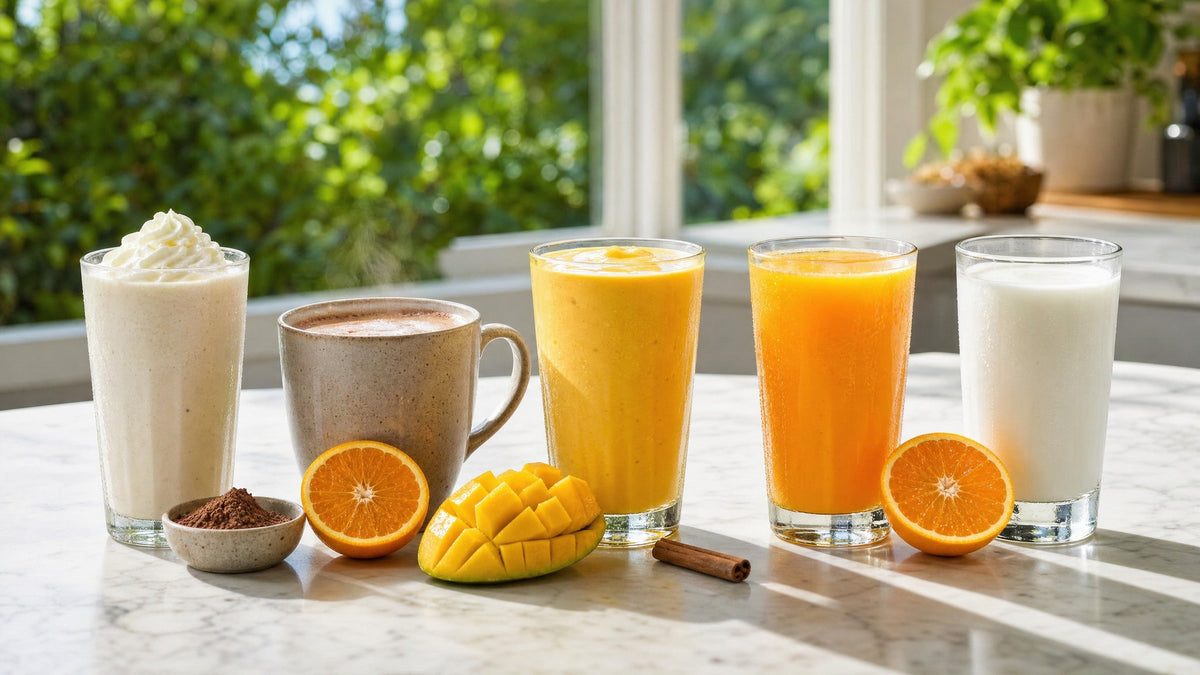
The most calorie-dense everyday drinks are milkshakes (approx. 300 kcal per glass), homemade shakes with milk, banana and peanut butter (approx. 350 kcal), hot chocolate with cream (approx. 250 kcal), lassi and cocoa (approx. 215 kcal each), as well as whole milk (approx. 160 kcal). Juices follow with approx. 115 kcal (orange juice) to approx. 175 kcal (grape juice). Plant-based drinks, buttermilk and coconut drinks are surprisingly low in calories: approx. 50 to 105 kcal per 250 ml glass.
This article answers the question for everyone who wants to gain weight: slim athletes, older people with a small appetite and their relatives. If you are losing weight unintentionally, please consult a doctor first to determine the cause.
The most important things in brief
- At the top: Milkshakes, hot chocolate with cream and homemade shakes (approx. 250–350 kcal per serving).
- Solid middle: Cocoa, lassi, banana milk and whole milk (approx. 160–215 kcal per glass).
- Below that: Juices (approx. 115–175 kcal), plant-based drinks, buttermilk and coconut drinks (approx. 50–105 kcal).
- Enriching is worth it: One tablespoon of peanut butter provides approx. 95 kcal, two tablespoons of cream approx. 90 kcal.
- No way to gain weight: Cola, energy drinks and alcohol.
- Drink between meals, not before. Medical nutrition for malnutrition should be used under medical supervision.
Contents
- Why drink calories?
- The big table: Calories per glass
- Surprise: These "healthy" drinks provide hardly any calories
- How to turn any drink into a calorie drink
- Drinks that do not help with weight gain
- When medical nutrition is the better choice
- Practical tips: How to drink more calories without overdoing it
- Frequently asked questions about calorie-dense drinks
Three figures for orientation:
Why drink calories?
Sometimes eating is difficult, or the demand is high: with a small appetite in old age, with intense training, or in a busy daily life with no time for meals. A glass is then often easier to manage than an extra plate.
The German Nutrition Society (DGE) advises older people: the less they eat, the more they should drink. If the overall energy intake is insufficient, it expressly lists energy-rich drinks as an option. The S3 guideline of the German Society for Nutritional Medicine (DGEM) on nutrition in old age recommends additional snacks and the enrichment of food and drinks; it notes that the data on snacks itself is sparse. Our calorie requirement calculator shows how much energy you need daily.
The big table: Calories per glass
Sorted by energy density. A glass is considered 250 ml; for two homemade drinks, the actual portion is given in brackets.
| Drink | kcal per 100 ml | kcal per glass (250 ml) | Protein per glass | Practical tip |
|---|---|---|---|---|
| Vanilla milkshake (ice cream parlor) | approx. 120 | approx. 300 | approx. 9 g | Lots of sugar, rather as a treat |
| Hot chocolate with cream | approx. 110 | approx. 250 (230 ml) | approx. 8 g | 200 ml cocoa plus 30 ml cream |
| Homemade peanut butter banana shake | approx. 105 | approx. 350 (330 ml) | approx. 14 g | See calculation below |
| Whole milk + 2 tbsp cream | approx. 90 | approx. 220 | approx. 8 g | Every glass of milk can be enriched this way |
| Mango lassi | approx. 85 | approx. 215 | approx. 7 g | Ready-made product varies by brand |
| Cocoa with whole milk | approx. 85 | approx. 215 | approx. 9 g | Depends on added sugar |
| Banana milk | approx. 75 | approx. 190 | approx. 7 g | Ready-made or homemade |
| Grape juice | approx. 70 | approx. 175 | approx. 1 g | Lots of fruit sugar, hardly any protein |
| Whole milk 3.5% | approx. 64 | approx. 160 | approx. 9 g | Base for enrichment |
| Kefir 3.5% | approx. 61 | approx. 155 | approx. 8 g | Pairs well with fruit |
| Fruit smoothie (ready-made) | approx. 60 | approx. 150 | approx. 2 g | Low in protein |
| Orange juice 100% | approx. 46 | approx. 115 | approx. 2 g | More of a thirst quencher |
| Oat drink (unsweetened) | approx. 42 | approx. 105 | approx. 2 g | Can be enhanced |
| Soy drink (unsweetened) | approx. 40 | approx. 100 | approx. 9 g | Protein content like cow's milk |
| Buttermilk | approx. 38 | approx. 95 | approx. 8 g | Hardly any fat, low in energy |
| Ayran | approx. 38 | approx. 95 | approx. 5 g | Refreshing, low in energy |
| Coconut drink (from a carton) | approx. 20 | approx. 50 | less than 1 g | Not coconut milk from a can |
All values are rounded estimates and vary depending on the manufacturer and recipe. The basis is the German Food Key and manufacturer specifications; the values for chocolate, shakes and enriched milk are our own calculations based on these. There is approx. a 250 kcal difference per glass between milkshake and coconut drink. You can find more energy-dense foods in our table of high-calorie foods.
Surprise: These "healthy" drinks provide hardly any calories
Those who reach for drinks with a good reputation often miss the mark when trying to gain weight. Oat drink (approx. 105 kcal per glass), soy drink (approx. 100), buttermilk (approx. 95) and coconut drink from a carton (approx. 50) are far below whole milk with approx. 160 kcal; kefir (approx. 155) and ready-made smoothies (approx. 150) are only slightly below. Soy drink and buttermilk provide about as much protein as whole milk, while oat drink and coconut drink provide hardly any. A latte macchiato also consists largely of coffee; its values vary so widely depending on size and added sugar that it is not included in the table.
Plant-based drinks remain a good choice if you do not want or tolerate cow's milk. Boost them: oat drink with one tablespoon of peanut butter comes to around 200 kcal.
How to turn any drink into a calorie drink
The DGEM lists natural ingredients such as cream, oil, butter and eggs, as well as maltodextrin and protein powder, for enrichment. Cream, peanut butter and banana are easiest in a glass:
| Addition | Quantity | kcal approx. |
|---|---|---|
| Whipped cream (30% fat) | 1 tbsp (approx. 15 ml) | approx. 44 |
| Whipped cream (30% fat) | 2 tbsp (approx. 30 ml) | approx. 90 |
| Peanut butter | 1 tbsp (approx. 15 g) | approx. 95 |
| Banana | approx. 100 g | approx. 90 |
The calculation example for the peanut butter banana shake from the table:
- 250 ml whole milk: approx. 160 kcal
- 1 banana (approx. 100 g) and 1 tbsp peanut butter: approx. 90 plus approx. 95 kcal
- Together around 350 kcal in approx. 330 ml, plus approx. 14 g protein
You can find complete recipes in the article Make Your Own Medical Nutrition: 7 Recipes. Athletes and hardgainers will find a mass gainer shake recipe.
Drinks that do not help with weight gain
Cola and energy drinks provide no more than orange juice (approx. 46 kcal) with approx. 42 and 45 kcal per 100 ml, respectively; a glass of cola brings it to approx. 105 kcal. "Energy" means caffeine, not calories. Both are essentially sugar without any significant nutrients. The World Health Organization (WHO) recommends limiting free sugars to less than 10% of total energy intake; higher intake leads to more cavities.
Alcohol provides 7 kcal per gram but is no way to gain weight. The DGE recommends abstaining from alcohol in its 2024 position paper.
Juices are not taboo, but contain hardly any protein and lots of fruit sugar. The DGE also lists pure juices and smoothies among the energy-rich drinks for older people. Drink them consciously, pay attention to dental care, and do not make them a regular drink.
When medical nutrition is the better choice
Everyday drinks rarely exceed approx. 1.2 kcal per ml, while medical nutrition provides 1 to 3 kcal per ml according to the European professional society ESPEN. The DGEM considers it a measure alongside others for older people with malnutrition or a corresponding risk, if usual and enriched meals, along with advice, are likely to be insufficient. The guidelines differ regarding quantities: the DGEM recommends at least 300 kcal daily, while ESPEN recommends at least 400 kcal including 30 g of protein. Both should be part of medical planning. Medical nutrition does not have to come only after other measures have failed, and it does not preclude enrichment. According to the DGEM, it should be taken between meals, not with or instead of them; ESPEN advises checking its effect monthly.
CaloDrink Vanilla
Ready-to-drink and fully balanced: 200 ml provide 300 kcal and 12 g of protein (1.5 kcal per ml). Gluten-free, low in lactose, made in Germany. It is intended as a dietary supplement with 1 to 3 bottles daily. Serve chilled; an opened bottle lasts 24 hours in the refrigerator.
Food for special medical purposes (balanced diet) for the management of existing or imminent disease-related malnutrition. Use only under medical supervision.
Whether medical nutrition is appropriate is decided by the doctor. If existing or imminent disease-related malnutrition is diagnosed, CaloDrink Vanilla can be prescribed on a medical prescription under § 31 SGB V; details can be found under CaloDrink on Prescription. Relatives can find further information in the Medical Nutrition Guide for Seniors.
Those who want more calories without an underlying illness will find a normal food product in the CaloDrink+ calorie shake powder: a 50 g serving provides 218–219 kcal with water, and around 378–379 kcal with 250 ml of milk. The powder contains at most 5 g of sugar per 100 g, contains milk protein, and is not lactose-free.
Calorie Shakes at a Glance
All shakes and powders at a glance.
To the calorie shakesDirectly to the CaloDrink+ calorie shake powder (strawberry, vanilla) or the ready-to-drink CaloDrink Vanilla (food for special medical purposes, use only under medical supervision).
Practical tips: How to drink more calories without overdoing it
- Drink between meals, not before. A full glass shortly before a meal often leaves the plate half full.
- Small glasses, but more often. A small glass seems more manageable than a large mug; several add up over the day.
- Set times. A drinking plan, for example in the morning, afternoon, and evening, is more reliable than "when you can."
- Vary the temperature and flavor. The DGEM advises varying flavors, portion sizes, and temperatures so that interest does not wane.
- A warm milk drink in the evening. Cocoa or warm milk with cream complement the day's energy and are a simple ritual.
- Water with a meal, the energy-rich drink afterwards. It should complement the meal, not replace it.
- Know your fluid intake. The DGE recommends at least 1.3, preferably 1.5 liters of fluids daily for seniors; ESPEN recommends at least 1.6 liters for older women and 2.0 liters for men. These values vary; your doctor will tell you what is right for you. According to the DGE, total requirements are around 2.25 liters daily, including fluids from food. Most non-alcoholic beverages hydrate similarly to water according to ESPEN, although the studies on this mostly involved younger people.
- If you have heart or kidney failure, clarify the fluid intake with your doctor. The DGEM points out that a restriction may be necessary in such cases.
Frequently Asked Questions About High-Calorie Beverages
Which beverage has the most calories?
Among common everyday beverages, milkshakes come out on top: approx. 300 kcal per glass (250 ml). Hot chocolate with cream and homemade shakes with milk, banana, and peanut butter follow. According to ESPEN, nutritional drinks provide 1 to 3 kcal per ml.
Can you gain weight with beverages?
Calories from beverages count toward your daily energy intake just like calories from food. Whether your weight increases depends on your overall balance. Drink between meals, not instead of them. If you experience unintentional weight loss, please consult a doctor first to determine the cause.
Is juice good for gaining weight?
Juice is not taboo (orange juice approx. 115, grape juice approx. 175 kcal per glass), but it provides little protein and a lot of fruit sugar. Drink it consciously, pay attention to dental care, and do not make it your regular beverage.
Which milk or plant-based drink has the most calories?
Among the unsweetened dairy products in the table, 3.5% whole milk takes the lead with approx. 64 kcal per 100 ml (kefir approx. 61, buttermilk approx. 38). Oat drink (approx. 42) and soy drink (approx. 40) are tied, while carton-packaged coconut drink comes in last with approx. 20.
What do seniors with little appetite drink?
Small glasses between meals are practical, for example cocoa, banana milk, or whole milk with a little cream. Pay attention to the fluid intake (DGE: at least 1.3 to 1.5 liters). If appetite continues to decline, you should consult a doctor.
Does the health insurance cover nutritional drinks?
If your doctor determines that you have or are at risk of developing disease-related malnutrition, ready-to-drink nutritional drinks can be prescribed on a prescription covered by statutory health insurance under § 31 SGB V; CaloDrink Vanilla is listed in the Lauer-Taxe for this purpose. Use only under medical supervision. Everyday beverages and powders such as CaloDrink+ are not covered by a prescription.
Drinking calories is a matter of selection and timing: whole milk, cream, banana, and peanut butter turn a glass into a snack; small portions between meals make them easier to consume. If you have a persistently small appetite or unintentional weight loss, please speak with your doctor.
- German Nutrition Society (DGE) (n.d., © 2025): Fit im Alter – Trinken im Alter. Online, accessed 18.10.2026. fitimalter-dge.de
- Volkert D, Bauer J, Benzinger P et al. (2025): S3 Guideline Clinical Nutrition and Hydration in Older Adults. Published by the German Society for Nutritional Medicine (DGEM) in cooperation with AKE, GESKES, and DGG. Aktuelle Ernährungsmedizin 50(4):220–283. doi:10.1055/a-2548-7209. AWMF Registry No. 073-019. dgem.de
- Volkert D, Beck AM, Cederholm T et al. (2022): ESPEN practical guideline: Clinical nutrition and hydration in geriatrics. Clinical Nutrition 41(4):958–989. doi:10.1016/j.clnu.2022.01.024 pubmed.ncbi.nlm.nih.gov
- World Health Organization (WHO) (2015): Guideline: Sugars intake for adults and children. Geneva: WHO. ISBN 978-92-4-154902-8. who.int
- Richter M, Tauer J, Conrad J, Heil E, Kroke A, Virmani K, Watzl B on behalf of the German Nutrition Society (DGE) (2024): Alcohol – Intake in Germany, health and social consequences, and derivation of recommendations for action (DGE position). Ernährungs Umschau 71(10):125–139 + eSupplement. dge.de
- Max Rubner Institute (MRI): Bundeslebensmittelschlüssel (BLS) – German Nutrient Database. Accessed 18.10.2026. blsdb.de
- Manufacturer information (labels) and calculation examples: own compilation and calculation. Product data for CaloDrink Vanilla and CaloDrink+.
The laws, guidelines, scientific publications, and databases mentioned relate to nutrition and supply in general, not CaloDrink or other CaloShop products themselves. Product information for CaloShop products is excluded; it comes from their labels and nutritional information.
This article is for general information purposes and does not replace medical or nutritional therapy advice. If you experience unintentional weight loss, illness, or swallowing difficulties, please consult a doctor. As of: September 2026.


 Vorkasse – Banküberweisung